





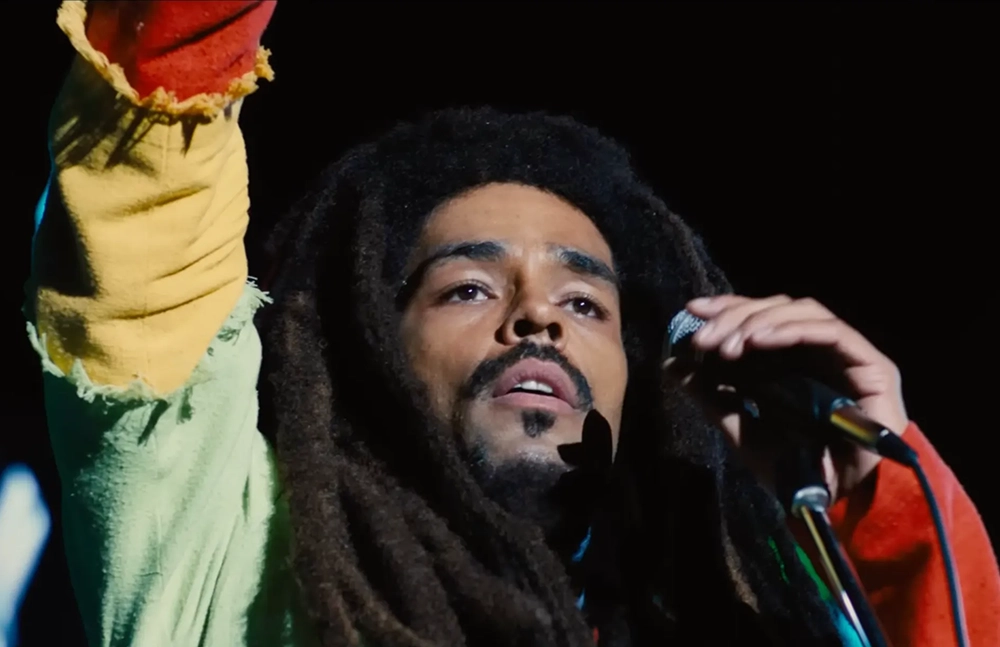
âBob Marley: One Loveâ is an authentic experience. Seeing it called âincompleteâ or âimperfectâ as a biopic is, I feel, a disservice. The reason for this is âOne Loveâ is not a simple biopic. Iâd actually argue itâs experiential and immersive rather than a film that connects the dots from an unknown music man to stardom. Itâs also a film that deals with a country in strife and cultural teaching, which may be something audiences arenât used to seeing in biopics. Thereâs of course also the fact that Bob Marley was (and remains to be) hugely influential, and has been placed on a pedestal. But “One Love” isnât afraid to insert its viewers headfirst into his life, nor to show his dark side. In the end, itâs a picture that wholly works on an emotional arc and its call to hope. Itâs not a rise to grace film, but I think itâs all the better for it.Â
When we first meet Marley (Kingsley Ben-Adir in a transcendent performance), heâs at a press conference with his manager, Don (Anthony Welsh). People want to know if heâs still planning to play an upcoming peace concertâthe immortal âSmile Jamaicaâ festivalâdespite political tensions, violence, and threats. Marley is politicalâmake no mistake about it. But heâs a peace advocate, and weaves and skirts the questions as best he can. That night two political extremists would break into Marleyâs home, shooting and wounding Marley, his manager, and his wife. The clincher on this scene, and Marleyâs integrity, is the moment when he locks eyes with the assailant before he pulls the trigger. Itâs not fear Marley feels, nor anger; he looks at the man with a sad entreaty, almost as a silent âitâs okay.âÂ
Marley Amidst a Struggling Jamaica
âOne Loveâ weaves along in this way, centering on Marley and his Wailers (his wife, Rita is part of the group, Lashana Lynch in an excellent portrayal) as they make music, records, and more. But Director Reinaldo Marcus Green doesnât paint a straightforward path, but one we have to feel and earn. The actorsâ strong, Jamaican accents could have been subtitled for viewers’ easeâas could have following Marley as a boy as he grew into a starâbut we would have lost something along the way. Green throws us in, asking us to immediately tread water, and by the end I was eager to, glad to follow this film and its characters as they learn, stumble, and grow.Â
In this way, it feels amiss to criticize âOne Loveâ for coming up short as a biopic, because itâs so much more than that. To paint the intricate Jamaican landscape of the 1970sâalong with Marleyâs riseâwould have taken a 3 hour plus run-time, and run the risk of telling instead of showing. By starting when Marley is already a star, and centering on the band and Marleyâs personal life amidst an uneasy culture, it allows us to feel his struggle. Part of the ease of this is the work Ben-Adir put into the role, one of the best performances Iâve seen in a biopic, bar none. I think most fans would have a hard time picturing anyone playing Marley. And while the film starts that way, in short time I forgot I was watching a representation and went with it smoothly. I grew up falling in love with âLegend,â Bob Marley and the Wailerâs greatest hits, but never spent much time thinking about what went into those songs, and what political climate Marley and crew wrote them in.Â
Music, Joy, and Pain
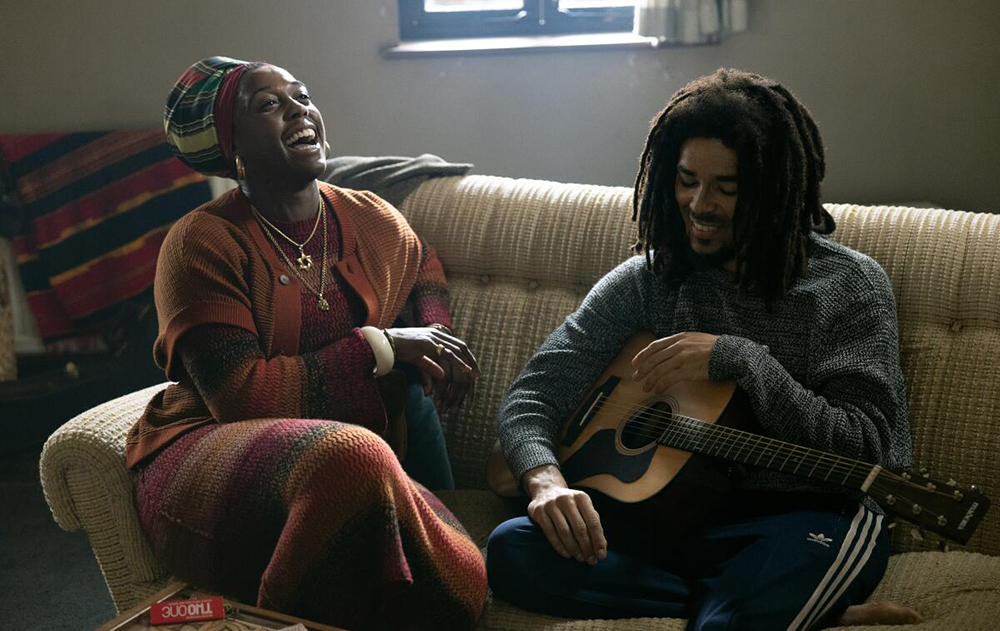
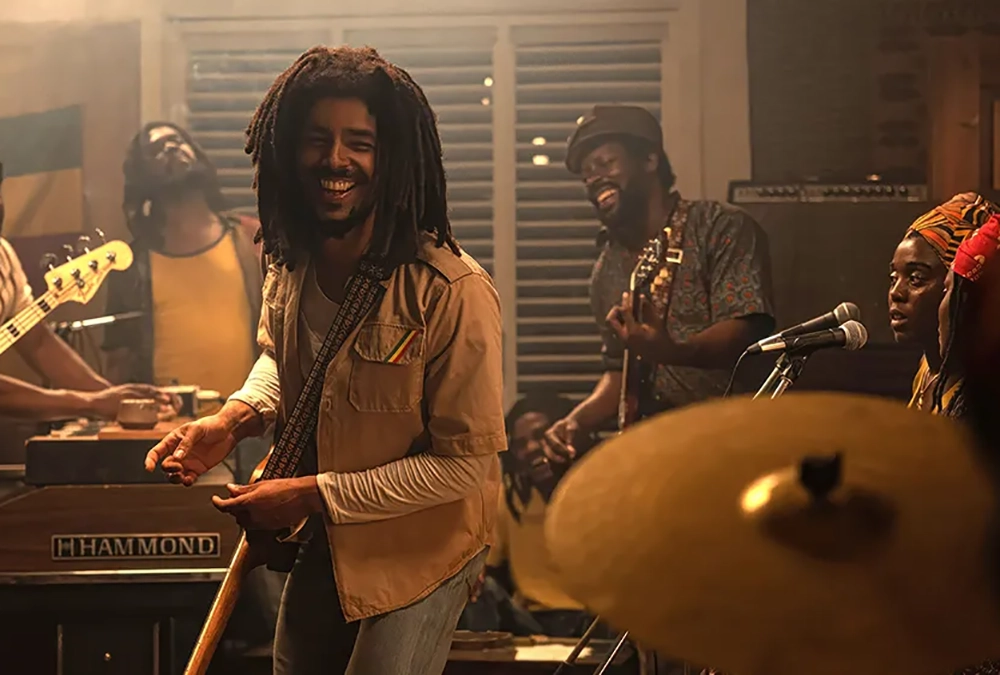
What works about âOne Loveâ is that for such a celebrated band, their practice rehearsals, songwriting, and recordings feel intimate and like family. They work as a unit, a factor that doubtless sprung from Marleyâs belief in Rastafarianism, of âone people.â One of my favorite parts of the film involves an interviewer asking him if he thinks humans can make it. Thereâs no anger on his face, but only a hopeful contemplation as he replies, âwe have to.â Thereâs a simplicity and hope to his logic that Ben-Adir sells with ease. But Greenâs film doesnât wish to just idolize Marley, but look into his heart. Adversity strikes him at many turns (an arrest in London and violence in Kingston being the most stark). But watch him as he spontaneously writes âRedemption Songâ or a scene where Rita comments on a love song he writes, urging him to hold on to that part of himself. Political songwriting and urges for peace consumed him at times, at her entreaty and knowledge of his soul is a moment of bliss amidst the pain.Â
The soundtrack for the film is stellar, featuring most of the bandâs greatest hits, but underscored and arranged for different scenes in an intimate way. The sound and music arrangements (Kris Bowers did the music) are joyous and celebratory. Some renowned tracks such as âJammingâ and âExodusâ are included as part of band rehearsals. Meanwhile âNo Woman No Cryâ scores one of the harder parts of the film, while âRedemption Songâ one of the most tender.Â
A Historical and Emotional Film
The film is enhanced upon learning that Marleyâs son, Ziggy, approved Ben-Adirâs casting and oversaw the film for authenticity, but that Ben-Adir also sang for the film. His voice is magical, imbuing what you feel is Marley really singing, although the filmâs concert scenes feature a blend of Marley and Ben-Adir’s vocals. The way the sound department weaves and transitions is seamless, and he joins Taron Egerton of âRocketmanâ fame for killing it in the singing department.
Additionally, the concerts are a joy to behold, and as the bandâs album âExodusâ went gold, you can feel their elation along with them. And the filmâs closeâas Marley holds a concert as he returns to Jamaicaâfeels exuberant. As captions inform of his accomplishments, as well as his death (interwoven with clips of the real Bob Marley and the Wailers), the film leaves a bittersweet yet emotional experience that stays with you.Â
A Film to Revisit
At the end of the day, âOne Loveâ is a great experience. It has its criticismsâmostly its short run-time and the fact that it tries to cover such an intricate and complicated period of history along with a biopicâbut to me, itâs all forgivable. The film sides you with Marley through his joy, hope, despair, and anger, without endorsing or forcing any of them. It touches on Marleyâs battle with cancer without providing answers to the often-conspiratorial topic. Marleyâs relationship to Jamaica, to his wife, and to Rastafarianism are felt rather than told, and ends with the redemption he tried so hard to foster. Its criticisms seem misplaced (a ârottenâ 42%), while its audience score of 95% seems more authentic. âOne Loveâ didnât alter my love of Marleyâs music, it enhanced it. Listening to âExodusâ today from start to finish, I thought of the man and his struggles and undying hope more than its reggae chords and beats. Itâs a film about history and about a man, and one I will need to revisit to appreciate for all its intricacies.Â

“Bob Marley: One Love” is currently available to watch in theaters.Â




