





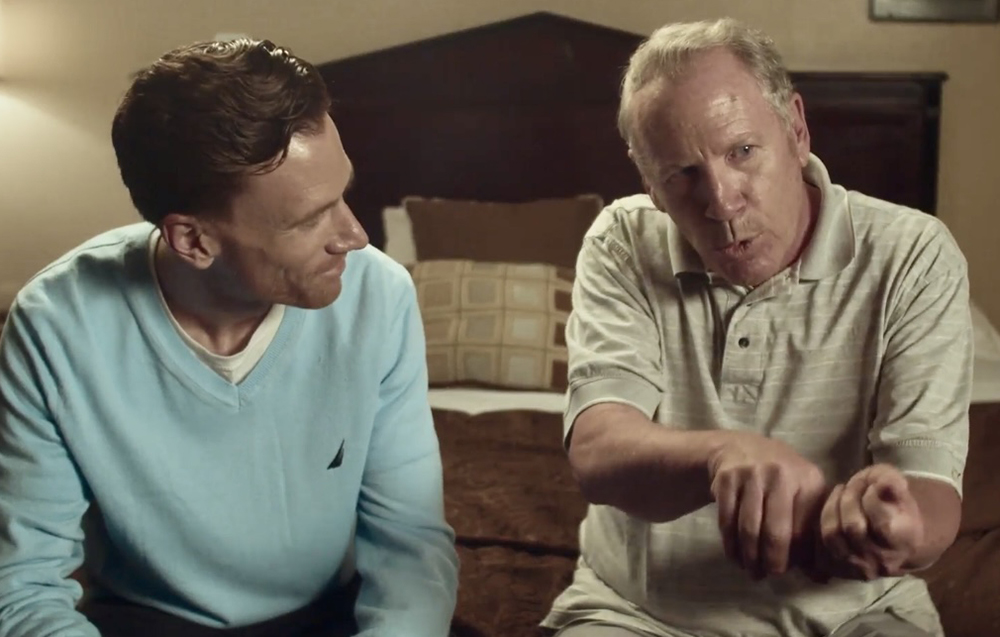
âPeabrain,â which I can only assume to be a passion project, is a sad but hopeful film. Written and directed by Steve Blackwood, the film’s about a son (Brian J. McDonald) caring for his elderly father, Phil, who suffers from alcoholic dementia. Blackwood plays the fatherâwho in round-a-bout ways gives us the filmâs titleâas he interacts with his son Craig, who used to be a soap opera star but now makes his own movies. Phil is stuck in his ways and deals with his memory problems through denial and subject-changing (while still surreptitiously drinking). But these arenât the saddest parts of the film. Blackwood isnât trying to make âThe Fatherâ here, or âAmour,â where we are dragged down emotional arcs as its protagonist(s) experience the pain that comes with memory loss. Blackwood instead intends to explore childhood trauma, which he does well. I feel his only misstep is in the filmâs short, 15-minute run-time, which doesnât feel enough time for recompense.Â
What works about âPeabrain,â is it’s an exploratory film that makes you think. Through early interactions with his father, Craig is drawn back to his childhood and verbal abuse at Phil’s hands. Itâs only a brief scene, but cutting. With only seconds of screen-time, Silas Robbins, who plays young Craig, makes us feel the pain. As does McDonald, who with lingering stares (unnoticed by an ailing Phil), shows us the pain that still remains. But what Blackwood does here is set up a moral dilemma: can we care about Phil, who is crotchety and quick to anger in dementia, when we know how his behavior as a younger father has left a lingering impression on Craig?Â
A film that asks tough questions
The answer isâI donât know. We see Phil act in some ways that are biting and irascible, such as referring to the physical therapist in the assisted living home as âthat colored guy.â He also cuts his son down in front of a nurse (Halle Curley)âwho loved Craig in the soap opera that got him famousâby referring to him as âdumbâ and âpea-brained.â His father gets a laugh out of it; as does the nurse. But where she feels it as gentle, elderly humor, she doesnât see the pain that lines its history. We see an inability for Craigâs father to see him for his strengths, which still affects Craig despite his success.
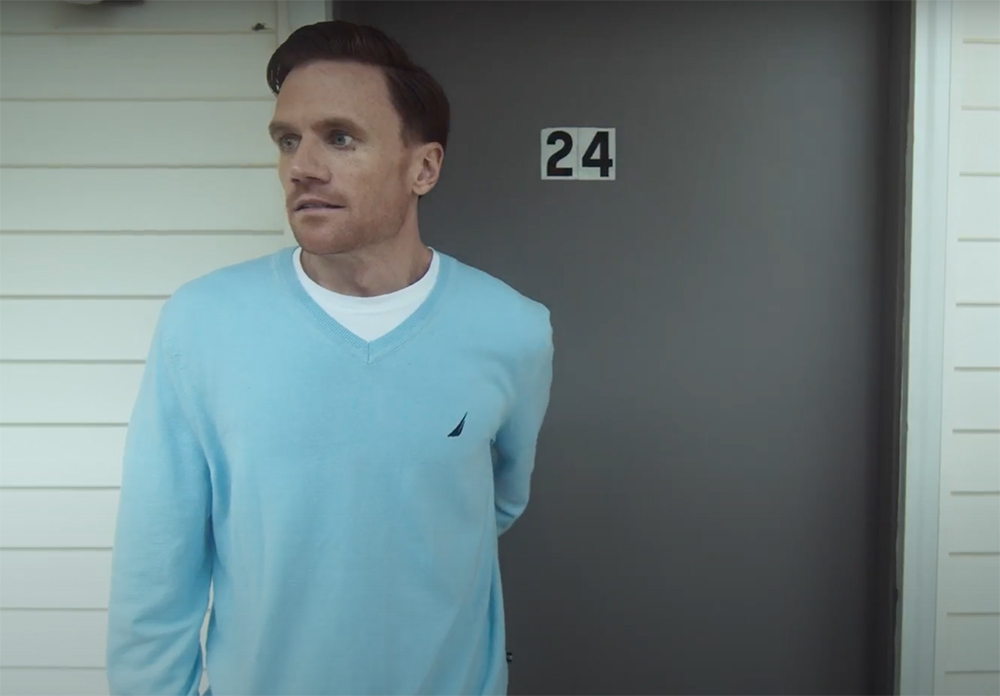
But âPeabrainâ doesnât want to vilify, Phil, and we get the impression there’s family strife between Craig and an off-camera sister, which the father urges him to forgive (âfamily are familyâ). Thereâs also the way that Blackwood and Cinematographer Jeffrey Buchbinder highlight Phil’s struggles. Their portrait of dementia feels real. In Philâs struggling memory, the team produces a really nice sceneâhighlighting a professional baseball memory he hadâthat brings a lightness to his character that almost forgives his treatment of Craig. Heâs himself again, and thereâs a real power to it.Â
Of course, all of this works because of the incredible performance by Steve Blackwood. His portrayal of dementia isn’t attention-grabbing nor heart-tugging. And in that lies its reality. Thereâs times where you can glean heâs having real problems understanding reality (a scam letter he receives being the filmâs most poignant), while other times itâs hard to tease out whether heâs suffering from memory lapses or just being recalcitrant. It all works because we believe heâs struggling. And as he later sips hidden liquor as his son travels back in time on the other side of the door, thereâs a pain and dolor for both that’s palpable.Â
Good performances and a hopeful message
McDonald is good here as well, and makes us believe he really cares about his father. His great moments are the ones where he remembers his pain. Others are equally strong as he navigates forging a relationship with his ailing father by sidestepping topics that anger Phil (his health) and focusing on the memories that make his dad happy. Thereâs also an unspoken sadness to the film, as we suspect Craig has never had the healing conversation with his dad he needs to, and now, given his dementia, itâs unlikely he ever will.Â
âPeabrainâ is a good film. Blackwood and McDonald turn in good performances, and the topics and discussions they have leave room for thought. The filmâs ending is apropos, and sums up its aforementioned themes while hinting at hope. My only complaint is its short run. A longer shortâor even a feature filmâwould have fleshed out Craig and Philâs relationship better, and offered some closure. But all-in-all, it makes you think. And given how much it makes you think after such a short run might be the filmâs crowning achievement.Â

“Peabrain” won a ‘Silver Award’ at the Paris Film Awards, and was a semi-finalist at the London International Filmmakers Festival. It is currently doing the festival circuit. Follow us for release information.Â




