






In the closing credits of Ruben Ãstlund’s Palme dâOr winner “Triangle of Sadness,” Michael Haneke is listed among those the director wishes to thank. The two share a kinship, not just as two-time Palme winners (a short list which includes just eight other directors) but also as provocative firebrands. And yet, although the two tend to probe similar issuesâfamily dissolution, upper-middle class delusion, fear of othersâtheir styles and storytelling structures diverge. Haneke is meticulous and distanced, while Ãstlund, far from a perfectionist, goes to extremes, and keeps going. In “Triangle,” Ãstlud has delivered a wild, unwieldy mix of playful satire and vicious commentary on [sub]-human nature. Itâs a true original that takes no prisoners, turning the jokes back on the audience, who canât help but laugh and gasp in equal measure.
Social satire films arenât ever guaranteed a long lifespan. Someâlike a few of Luis Bunuelâsâare timeless, while others (all of Adam McKayâs recent political polemics) have an almost immediate expiration date. What sets Ãstlund apart is his ability to carefully zero in on the micro concerns of the individual while zooming out to lambast the frustrating buffoonery of society. And with his last three films, including “Force Majeure” (2014) and the other Palme winner, “The Square” (2017), Ãstlund has walked a tight rope. He balances absurdity with grace, providing flawed creatures who canât help their own impulses. He blames everyone and no one, and does it in such an entertaining manner itâs easyâor just more convenientâto laugh first and think about the message later.Â
A Film Told in Three Parts
And the messages of “Triangle of Sadness,” despite residing in humor and natural beauty, are quite grim. The film is told in three parts, starting with Yaya (Charlbi Dean) and Carl (Harris Dickinson), two models in a relationship built on jealousy and social media likes. In several sharp but drawn-out sequences, we come to learn that Yaya is the breadwinner, and Carl is contemptuous of her success, up to a point. Thanks to Yayaâs Instagram success, sheâs able to take Carl on a luxury cruise for free. Which brings us to part twoâ¦
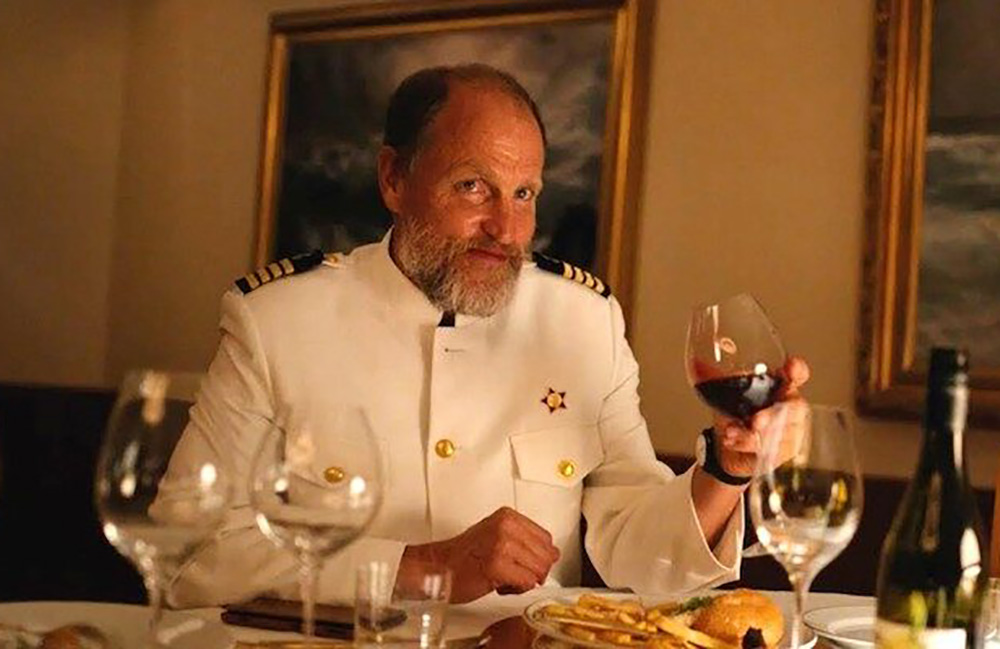
On the cruise, the happy coupleâs bickering escalates, instigated by a seemingly innocent flirtation that Yaya has with a deckhand. Carl swiftly complains, and has that employee fired. And then, the film kicks into high gear, introducing a cast of characters such as the wealthy Russian entrepreneur Dimitry (Zlato Buric), the shipâs drunken/Marxist Captain (Woody Harrelson) and Abigail, a cleaning lady (Dolly De Leon). There are others, of course, but thereâs only so much room in this review andâspoiler warning, in act threeâfor this Altmanesque ensemble. Ãstlund plays parts of act two for laughs, including a lengthy debate between Dimitry and the Captain (âA Russian capitalistâ¦and an American Communistâ) that comes after an already infamous seasickness scene. Another warning, although perhaps youâve heard by now: thereâs lots of vomit and diarrhea.Â
A Finale that’s Both Unresolved Yet Satisfying
Well, there isnât much to say about act three that doesnât reveal plot points, since so few of the cast members are present for this portion. If parts one and two are Altman plus Bunuel with a hint of Fellini, act three is pure Ãstlund; he offers his own take on “Lord of the Flies” and the saying, âeat what you kill.â Only a few of the shipâs passengers survive a pirate attack. The film glosses over the particulars of this, except for a grenade that lands on the boat which an older British couple picks up (Amanda Walker and Oliver Ford Davies). They’ve made their money sellingâ¦grenades, or as the husband (naturally, the characterâs named Winston) puts it, products that have protected democracies around the world for generations.Â
Whereas the rule on the ship was to not say no to anything a guest requests, the rules on the island are all according to Abigail. Sheâs the only one able to catch and cook dinner, start a fire, and all she asks for in return is for a simple series of favors from Carl, despite Yayaâs protests. Act three belongs to Abigail, and De Leon is commanding in this delicious role. While I did wince when the audience clapped at her saying, âOn the ship, cleaning lady, here: I am captain,â it was the only way she could have conveyed her new status. That line is Ãstlundâs strongest nudge to pat themselves on the back, and he has a gift for dangling such tasty bait. The resolution of this love triangle accelerates the film to its conclusion at a breakneck pace, to a finale thatâs both unresolved and satisfying.Â
Arthouse, but Plenty of Humor and Commercial Appeal
All that people are saying of this film is probably true. Itâs in no way subtle about delivering key themes, but nothing is subtle about the film or the people who made it. In a pre-Covid world, this is the kind of arthouse movie (glossy, vulgar, and aggressive) that would do a respectable U.S. Box Office, and it could still sneak into the Academy Awards conversation. Thereâs also plenty of humor and commercial appeal, and when I heard the entire audience howl at the repetitive cries of one character (a wheelchair-bound stroke victim), itâs clear who the jokeâs on. Ãstlundâs latest is a divisive wail at the world, and we have him to thank, and ourselves to blame.Â
âTriangle of Sadnessâ is part of our continuing coverage of the 2022 New York Film Festival (NYFF).
Support the Site:Â Consider becoming a sponsor to unlock exclusive, member-only content and help support The Movie Buff!


