






A doctoral student in astronomy discovers a comet one night at work. Before this big discovery, nothing was out of the ordinary: she works while rapping along to Wu-Tang Clan, with a Carl Sagan minifigure adorning her workstation.
But for some reason, thereâs something odd about the comet. And as her professor computes the ephemeris (the distance of the comet to Earth), that ‘something’ becomes more and more the thing.Â
The ephemeris keeps getting lower and lower.
Which means the comet is crashing toward Earth.
In 6 months and 14 days.
Suddenly, the celebrations of naming it Comet Dibiasky are immaterial.
Given all this abovementioned scenario, how would the world respond? Adam McKayâs latest film, âDonât Look Up,â sums up the reaction thusly:
“Meh.”
McKayâs Brand of Biting Satire Drives ‘Donât Look Up’ from the Get-Go
When Kate Dibiasky (Jennifer Lawrence) and Dr. Randall Mindy (Leonardo DiCaprio) both discover the comet heading toward Earth, they go through the rigmarole of briefing their superiors. Their superiors, in turn, phone their own superiors to ask for advice on how to proceed. The bureaucracy involved in the decision-making process is a nightmare, and both Dibiasky and Mindy experience it firsthand.Â
Eventually they make it to the White House accompanied by Dr. Teddy Oglethorpe, head of the Planetary Defense Coordination Office (Rob Morgan in a nice supporting role). For the trio, a comet 5 to 10 kilometers wide means an extinction-level event once it hits Earth. Thus, itâs a no-brainer to assume that the most powerful person in the world would be just as worried, if not more.
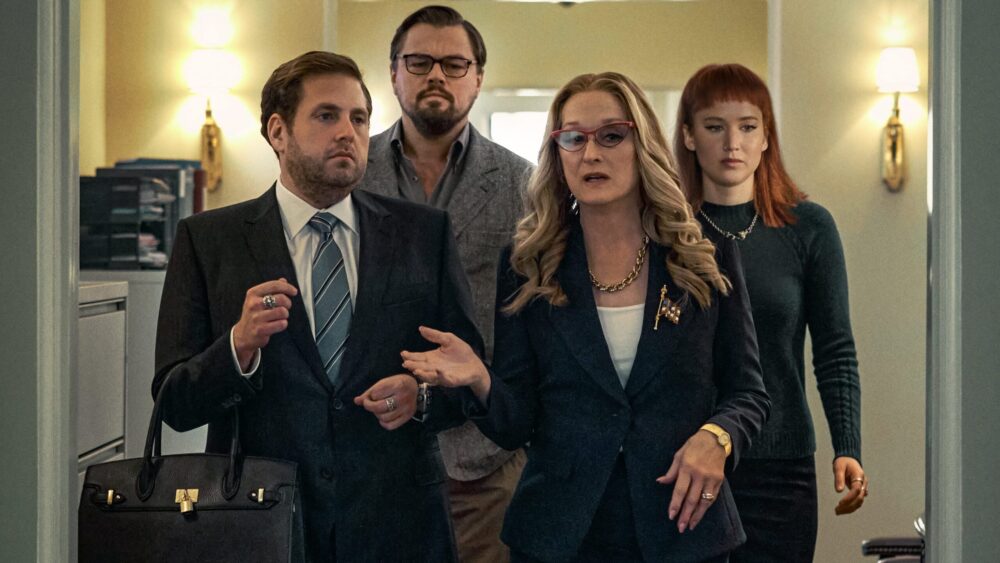
Enter US President Janie Orlean (Meryl Streep in an effectively annoying role), a character the filmmakers clearly based on a former US president. Along with her Chief of Staff, son Jason (Jonah Hill), Orlean exudes an air of wildly misplaced self-importance thatâs become everyday fodder in the modern worldâthanks to the spate of elected officials in the real world. Â
So, again: how do you tell the most powerful person in the world that humankind has only six months left before mass extinction? Oglethorpe does just that, telling Jason that what Mindy and Kate are there for involves real-life threats to humanity. Jason, in response, asks for five minutes because âwe have a problem with our Supreme Court nominee.â
On the Basis of Politics Surrounding (and Sidestepping) Environmental Issues
Frustration boiling, Dibiasky and Mindy ask as they wait for their turn to speak to Orlean, Why does no one give a damn about the situation? Or more accurately, Why is nobody taking the situation seriously?
Much of the merits of âDonât Look Upâ rests upon its depiction of the weird reality we live in right now. Twenty-five years ago, a film that satirizes incompetent leaders and overall bad governance would have looked way more different than what this movie shows. However, given the proliferation of âcolorfulâ world leaders weâve seen over the past few years; how the filmmakers show Streepâs President Orlean arguably passes as an accurate representation of those leadersâ incompetence.
Probably the biggest takeaway in the film apart from the satire is its attempt at providing a scathing commentary on how critical issues affecting mankind still end up being used as political tools to forward a leaderâs personal agenda. The film portrays Orlean stoking her fanbase to discredit Mindy and Dibiaskyâs discovery; only to capitulate and support the two in order to divert the publicâs attention when she figures in a scandal. Shortly after, she again reverses course and discredits the two anew when one of her billionaire donors (Mark Rylance in a quirky role) insists on allowing the comet to crash on Earth due to the elements that could be worth trillions of dollars.
Whereas itâs easy to point out how itâs the politicians in America who decide on the fate of environmental laws combating climate change, such politicking (and stonewalling) is prevalent worldwide. And when money is involved, itâs usually the capitalistic âto hell with safety; letâs get on with itâ mentality that ultimately prevails. Not surprisingly, for DiCaprio, the themes of this film in particular hit close to home. As a staunch advocate for environmental issues, the actor has promoted causes aimed to combat climate change; and trying to avert the extinction event depicted in âDonât Look Upâ serves as his call to action.

Just Look Up vs. Donât Look Up: The Role the Media Plays in All This Chaos
At the same time that the White House prioritizes their controversial Supreme Court pick over the comet heading toward Earth; the social media focuses on a celebrity breakup and not the potential cataclysmic event.
Talk about priorities on both aspects of the media.
Imagine this type of content you see on everyday social media (and even news outlet) posts.
Thereâs a comet fairly visible from the sky about to land on Earth in a few monthsâ time. Do you:
- Destroy the comet and save mankind?
- Allow it to crash, potentially killing everyone, but which will create countless jobs?
- Really believe itâs a comet? Eh. Fake news.
Tell us what you think. Donât forget to use the hashtags #JustLookUp or #DontLookUp. Vote now!
And this is what made me appreciate the film. While Iâve had my own niggles with how McKay handles serious topics (this film included), âDonât Look Upâ succeeds in showing the ugly side of politics and the misuse of both the Fourth Estate and social media. The movie accurately depicts how sensationalism today can stoke panic, fear, and mistrust among the public. Suddenly, science doesnât matter as much anymore, when it contradicts oneâs personal truths.
Then thereâs the subtext involving Dibiasky and Oglethorpe. In light of her meltdown during a TV interview on The Daily Rip (Cate Blanchett as co-host Bree Evantee is perfect casting) when the hosts donât take her and Mindy seriously; Dibiasky goes on a rant, prompting online bullying and mockery. Later on, when President Orlean realizes she could use the situation to her selfish interests, her administration appoints Mindy as Science Advisor to the Presidentâsidelining Dibiasky and Oglethorpe in the process. Iâd like to think that the filmmakers put it in to comment on the gender and racial discrimination that the âreal people who actually do the jobâ experience every day. Sure, itâs a little forced, but itâs a nice touch nonetheless.

A Film too Focused on Landing Its Barbs Over Telling a Coherent Story
Despite the commendable aspects of the film, the biggest problem is its tone. McKay, working on a story he developed with David Sirota, clearly approached âDonât Look Upâ the same way he did on his earlier films. However, he just simply went ballistic with the barbs here; satirizing the incompetence and self-righteousness by the people in power so much that the film becomes preachy at times. That air of condescensionâas if the bad guys here are just stupid as a rockâcan leave a bad aftertaste in some of the audiences. And while I personally donât mind, I’d understand it if people ended up hating this film to a tee.Â
Midway through the film, it becomes evident that McKay enjoyed himself too much here; thereâs a lot going on that a clearer focus wouldâve been much more appreciated. In fact, the jarring editing courtesy of Hank Corwin can be challenging for even the filmâs most ardent supporters; since some scenes didn’t need rapid-fire cuts, and yet the movie does it with maniacal glee.
“Just Look Up!”: Adam McKay at His Usual Be-Angry-While-Laughing ModeÂ
Having that said, I enjoyed âDonât Look Upâ a great deal. After all, itâs a riot of a film that uses real science to poke fun at todayâs crazy world. But then, it’s also evidently a work of a scatterbrain putting a hat on a hat with its satire. McKay may have intended for this film to be this generationâs âWag the Dogâ with the same formula he used on âThe Big Shortâ; which ultimately netted him the Academy Award for Best Adapted Screenplay. Despite that, however, âDonât Look Upâ ultimately feels more like his previous film âViceââbut on steroids.
âDonât Look Up,â heavy-handed and almost-condescending approach aside, might end up as the most talked-about and polarizing film of 2021âand rightfully so. My only problem is that, for all its good intentions, the movie busies itself with satire so much, it sometimes forgets to tell a proper story. Thankfully, the performances of its star-studded cast more than make up for what could have been the yearâs biggest misfire. And for me, it’s enough to ‘just look up’ and enjoy the wild ride.

Support the Site: Consider becoming a sponsor to unlock exclusive, member-only content and help support The Movie Buff!


