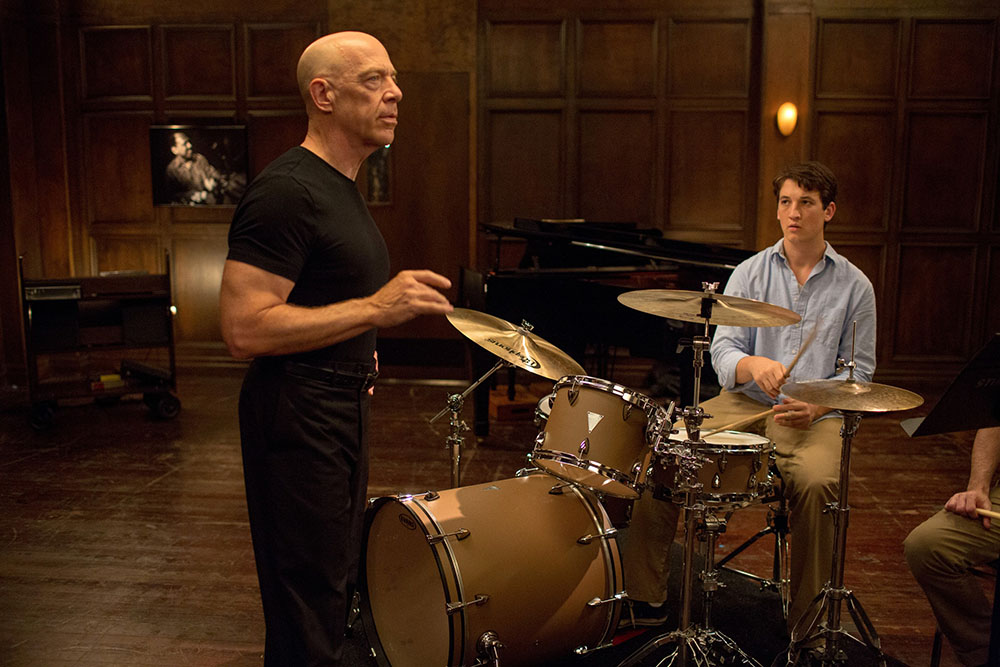
Advanced knowledge by this writer of several snippets of the film âWhiplashâânamely its supporting actor J.K. Simmons winning an Oscar by berating music students with physical and emotional abuseâleft me with an incorrect assumption going into this film: that its protagonist, Andrew (Miles Teller) is a victim. But âWhiplashâ is anything but. This is not a film with heroes and villains, or even one of right and wrong. Itâs a film that drops you into its setting quickly and forcefully, and sets up characters that are anything but perfect. That word âperfectâ comes up a lot; itâs something its characters strive to be, damn the cost. Hell, damn any cost.Â
The Best Thing this Side of Perfection
The film centers on the aforementioned Andrew, a gifted drummer who has enrolled in Shaffer Musical Conservatory, this movieâs obvious fictional stand-in for Juilliard. The opening scene sees him drumming by himself in a practice room; heâs sure of himself but not too sure. It isnât long before Fletcher (Simmons), who we can only assume is the best teacher in the place, watches him, observes him, and quickly walks away, slamming the door when he doesnât like what he hears. What doesnât he like? Itâs something reserved only for the best; mistakes when seeking perfection are clear only to the few.Â
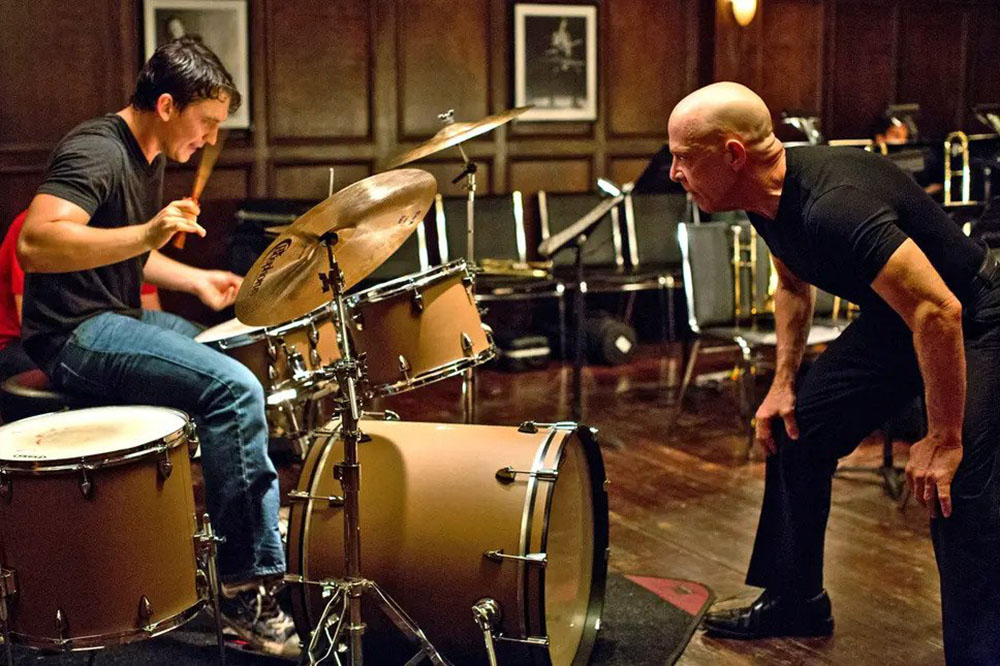
It isnât long before Andrew gains a place as an alternate in Fletcherâs studio band; and the way Fletcher and Director Damien Chazelle wind up the proceedings, itâs clear where âWhiplashâ got itâs name. âWhiplashâ is a piece of Jazz music; itâs also the neck-jerking way Chazelle rips his characters from one emotion to the next with no segue. One moment newcomer Andrew is filled with encouragement from Fletcher; thereâs a reason heâs here [at Shaffer]Â after all, and itâs to make good music and learn. However, the next moment, when Andrew canât keep time, heâs a âworthless fuckâ and Fletcher throws a chair at him.Â
Of course, this is all meantâin Fletcherâs mindâto encourage Andrew, like other students, to âbe the best.â We learn of a past student of Fletcherâs who went on to success but then hung himself. The scene is apropos; Fletcher lies about the cause of death when he tells his students, but seems genuinely affected, tearful. His obliviousness of his role in this student’s suicide would be clinical if he didnât know better, but he does. He believes pushing is necessary to achieve greatness, and only the great can accept volatile, abusive pushing and grow. The rest are weak, to be shipped off to lesser projects (in one of the filmâs most elitist snobs, we see a poster that reads: âThose Who Are Not Good Enough Play in Rock Bands’).Â

A Fine Line Between Abuse and Inspiration
In its way, âWhiplashâ then sets up its abusive teacher/student relationship between Fletcher and Andrew. But the key here is that as toxic a person as Fletcher is, Andrew is no saint. He seems to ride a fine line between just a little cocky and downright elitist, and his malleable personality shifts and edges depending on wether or not heâs currently in Fletcherâs good graces. When Fletcher approves of him, heâs on cloud nine; when he doesnât he hates the world, and probably himself.
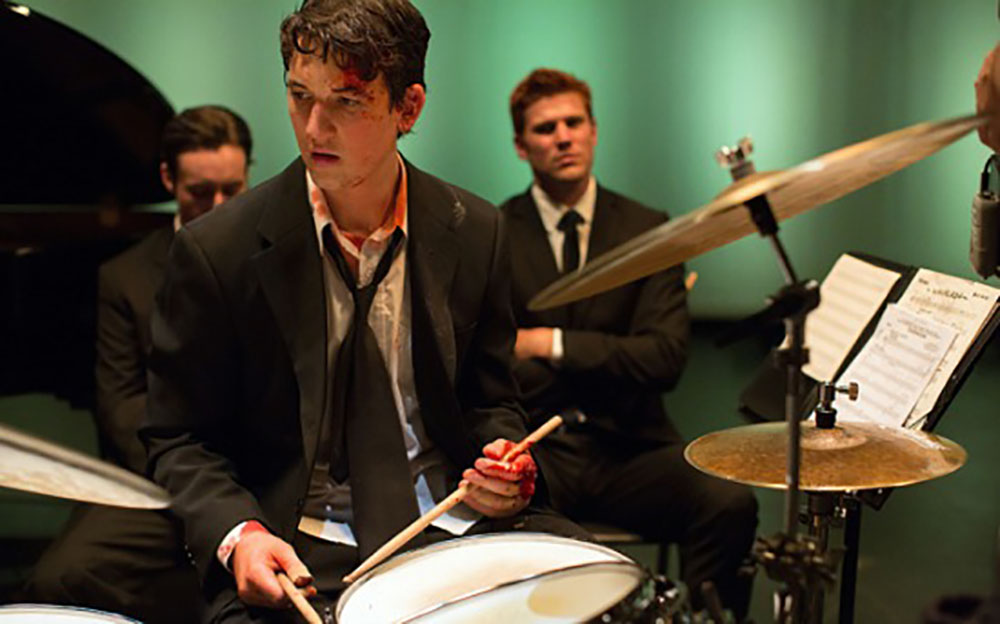
A scene in a diner where he breaks up with a nice girl heâs dating (Melissa Benoist) because heâs certain sheâll stop him from reaching his dreams is startling. But itâs not long before he begins taking on a sense of inflated egotism and Fletcherâs worse qualities, berating his own bandmates with the same vitriol as Fletcher. Fletcherâs blessing is everything to him, but Fletcherâs abuse pushes him even further. And as Andrew shows up to play after being literally hit by a truck, blood dripping over his drum set, itâs hard not to see the parallel: perfection is literally killing him.Â
There are plenty of actors that fill this film, most notably âMad About Youâsâ Paul Reiser playing Andrewâs loving father, but letâs be honest: âWhiplashâ is about Miles Teller and J.K. Simmons, and they both excel in their roles.
Simmons is in complete command here. He strikes you as both an erudite who wears the title âprofessorâ as something to be proud of, but is cold, calculating, and mostly emotionless. He dresses in all black for the film, no doubt purposive; yet seems draped in muted blues and greys when we see him playing a soft piano in a Jazz club later. The music is slow, beautiful, soulful. Is this the same man who made Andrew count to four while slapping his face just an hour ago? Simmonsâ Fletcher is the type of man to whom abuse comes as easily as breathing. It comes so easily, in fact, that we believe, watching him, that he doesât even see it as abuse. He sees it as the goal of a good teacherâto inspire.Â

A Cautionary Tale of Seeking the Best No Matter What
Alongside him, Teller plays the eager student, the one who is inspired to do better the more abusive Fletcher becomes. Heâs a man driven by one purpose, perfection, and one who doesnât see a need for friends or colleagues in any traditional sense. His tunnel vision drives him to perfection. And the end of the filmânot to be spoiled hereâfeaturing a showdown between Fletcher and Andrew has the raw power of awe. Weâre not seeing the triumph of a disgraced student finally coming into his own; weâre witnessing a perfection-asker seeing perfection. But the result is not pretty, or triumphant. In fact, itâs so ugly that Andrewâs own father canât even watch. Fletcher is ecstatic with purpose, while Andrew bangs away at the drums with a fatigue and anguish that is nothing less than a dying human on autopilot. The events don’t feel glorious, but uncomfortable.Â
All-in-all, âWhiplashâ is a great movie. It features a great Miles Teller, and J.K. Simmons at his absolute best. Itâs an exploration of music, an exploration of perfection, and a cautionary tale for mental health and how far some will push themselves to say they were âone of the greats.â Is someone great if that greatness then causes them to kill themselves for the role? âWhiplashâ asks those questions silently, but never out loud. To ask them out loud is weakness. But as the film ends, you realize youâve stumbled upon something profound. Simmons, Teller, and Chazelle ask you to get comfortable with being uncomfortable and ask hard questions when the credits roll. The best movies make you think after they end; âWhiplashâ is a stellar case in point.Â
“Whiplash” is available to watch or rent through most streaming platforms.Â