Julia Ducournauâs âTitaneâ is a unique, feral, and riveting masterwork that conjures the magic of imaginative filmmaking as it blends body-horror, dark comedy, and drama.
French director and screenwriter Julia Ducournau is one of the most exciting filmmakers coming up right now. Every single piece of work she does has a verve, and it yells passion all going back to her short, âJunior,â which won her the âPetit Rail dâOrâ at the Cannes back in 2011; it focuses on the aspect of puberty and how awful it can be. Looking at it like that, it may not seem as much, but when you see the short, you notice how she managed to capture that topic while adding a bit of body-horror nastiness to it.
The movie that got her into the spotlight was âRawâ (2016), my favorite film of all time. It does some justice to pictures that dealt with the âsins of the fleshâ like Claire Denisâ âTrouble Every Dayâ (2001) and âThe Cook, the Thief, His Wife, and Her Loverâ (1989). The film has some âprovocativeâ scenes and centers around horror concepts, yet I donât see it as a horror flick; it doesnât play like one. It is more like a drama about a woman getting to know her true self and trying to fit in on one of the circles, or cliques, in the world.
Five years after delivering the impactful âRaw,â she goes on to provide one of the most unique, mysterious, and unnerving features in the past couple of years, âTitane,â which won Ducournau the âPalme dâOrâ this year at Cannes. You have not seen anything like this, and it is not what anyone was expecting; it is fueled by ambition, punk, flair, warmth, gore, and smarts. It is the definition of creative filmmaking, an adoration to her idols, and a love letter to horror. The film amazes and perplexes by the end, but trust me, it is magnificent and truly worth it.
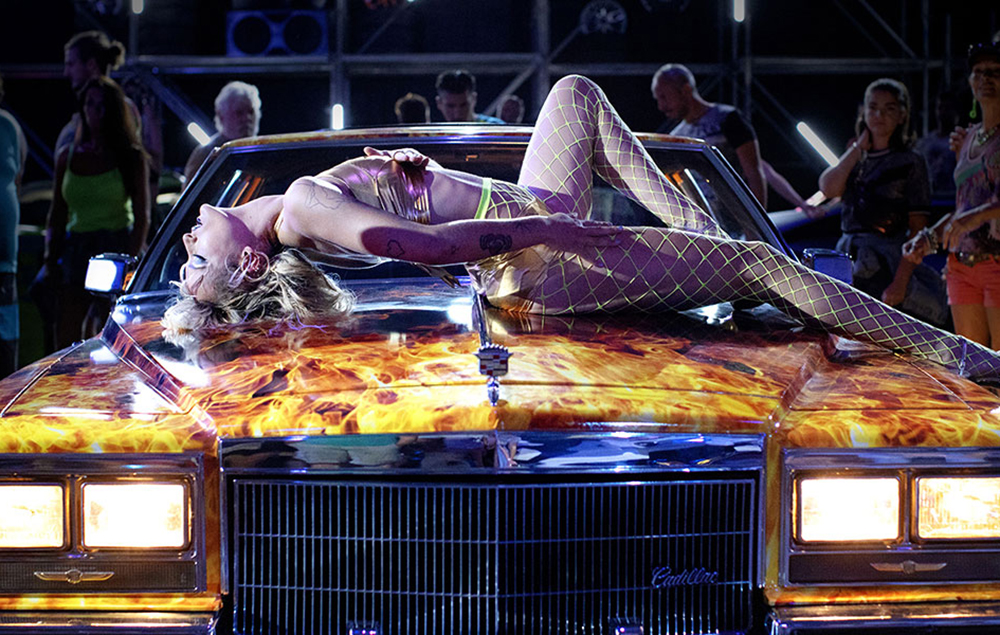
It all starts with Alexia (Agathe Rousselle) and her family getting into a car crash, which causes her to get a titanium plate contoured into her head. During her recovery process, she turns back on her parents in favor of the car. Now grown up, Alexia is still in love with cars, even working as a showgirl at a motor show. She dances on top of sports cars and has many fans who ask for pictures and autographs because of it. Unfortunately, one of her fans starts following and bothering her, making Alexia defend herself and brutalize the man.
After her event, she is wanted for attacking the man. It causes her to go on the run and adopt a male identity of a child missing for ten years. The father of the missing child, Adrien, the hyper-masculine firefighter Vincent (Vincent Lindon), accepts the story with great joy and open arms. His colleagues at the fire station donât buy the story as her gender becomes more unclear as the days pass. However, they let it flow, even though they still question it, for Vincent to project his vices onto Alexia. Meanwhile, Alexia is going through some adamantine changes that are kindling problems to hide whatâs happening to her.
The relationship between Vincent and Alexia is based on both dealing with abandonment in life. They both suffer trauma and accept each other as they find tranquility in their existence of a hard life together. Itâs two tortured beings connecting, finding their own identity. Alexia endures two transformations; one from becoming the missing child as she cuts her hair and breaks her nose on purpose to resemble the kid and the other a rapidly happening pregnancy. In both ways, she changes physically to adapt to the causes and hide her true self.
This story is made possible by Cronenbergâs New Meat, or the different fusions of the body. In this case, the coalescence between body and machine. The fetichism of how bodies and objects create an infusible relationship. It creates a bridge that unites smarts with the horrific, a thin line between sci-fi and horror, like âVideodromeâ (1983) or âThe Flyâ (1986). Brutality, sexuality, and deep emotions of love, lust, and loneliness go hand-in-hand to deliver a visionary narrative of individuality and self, albeit being bloody and fierce in the way of Gerald Karglâs âAngstâ (1983).
If you have seen âRaw“ (and if you havenât, I encourage you to do so), you see that Ducournau loves to blend her genres with the terror element. She tackled coming-of-age, drama, and dark comedy with body horror. That isnât an easy task to put upon yourself even when it is your feature debut; however, it all fits together in the best way possible as that combination helps to elevate the thrills. âTitaneâ does the same; it gets all those genres in a blender with a more violent sense and more muscular and bold filmmaking, ending in an expertly crafted thriller about identity.
The first fifteen to twenty minutes include excellent references. It’s evident Ducournau loves the work of body-horror technician David Cronenberg as she has referenced him in her films before. In âRaw,â we see some details like âRabidâ (1977) and âThe Broodâ (1979); and now, in her latest feature, she takes notes on the provocative âCrashâ (1996) and âDead Ringersâ (1988). John Carpenterâs âChristineâ (1983) is also present due to the obsession with the vehicle, and the car has a âmindâ of its own, and some actions take place inside it. There is also a bit of Tsukamotoâs âTetsuo the Iron Manâ (1989), as body and metal turn to one, and a small garnishing of Brian De Palmaâs work.
The performances are strong, although there isnât that much dialogue. Agathe Rousselle delivers an outstanding performance that I hope makes her a star. She relies on facial expressions, body mannerisms, and screams in a hypnotic and puissant way. She plays her role like a mime or silent film star in the 1920s because her character doesnât have dialogue. On the other side, Vincent Lindon delivers a sturdy performance; he is vulnerable while being the most macho man imaginable as his co-workers see him as that symbol of masculinity. And of course, she needed to be in this movie; âRawâ lead Garance Marillier is also in the cast. Even if she isnât in it that much, it is great to see her.
I was anticipating Ducournauâs sophomore film since the moment I finished her debut, and I can say that this didnât disappoint. For a horror movie to work, it must have up to par dramatic and emotionally grasping components in its back. That is one of the main reasons why âTitaneâ works. It has grounded moments that are touching while it is still violent and bloody. Bodies beat to a pulp, the blending of the carnal with metallic transformations, father-daughter junctures, darkly comedic jokes, great use of a jukebox, and the return of the Macarena. It has everything I would have hoped it had, and it brought more that I didnât know that I needed.
Of course, it is weird, ferocious, and it might not play to the larger movie-going audience, but it is unlike anything you have seen before in the last decade. That is the joy of it, seeing something so bold and audacious work perfectly. It might not have worked in the hands of another director; it isn’t supposed to when you look at it on paper. Yet, Julia Ducournau pulls it all together with proficiency, skill, and pure flair. If you like brains with your awful and the heart-rending while aggressive, this is for you. âTitaneâ is one of the best and most memorable films of the year.
This review of âTitaneâ is written from its screening at the 2021 Toronto International Film Festival (TIFF).Â