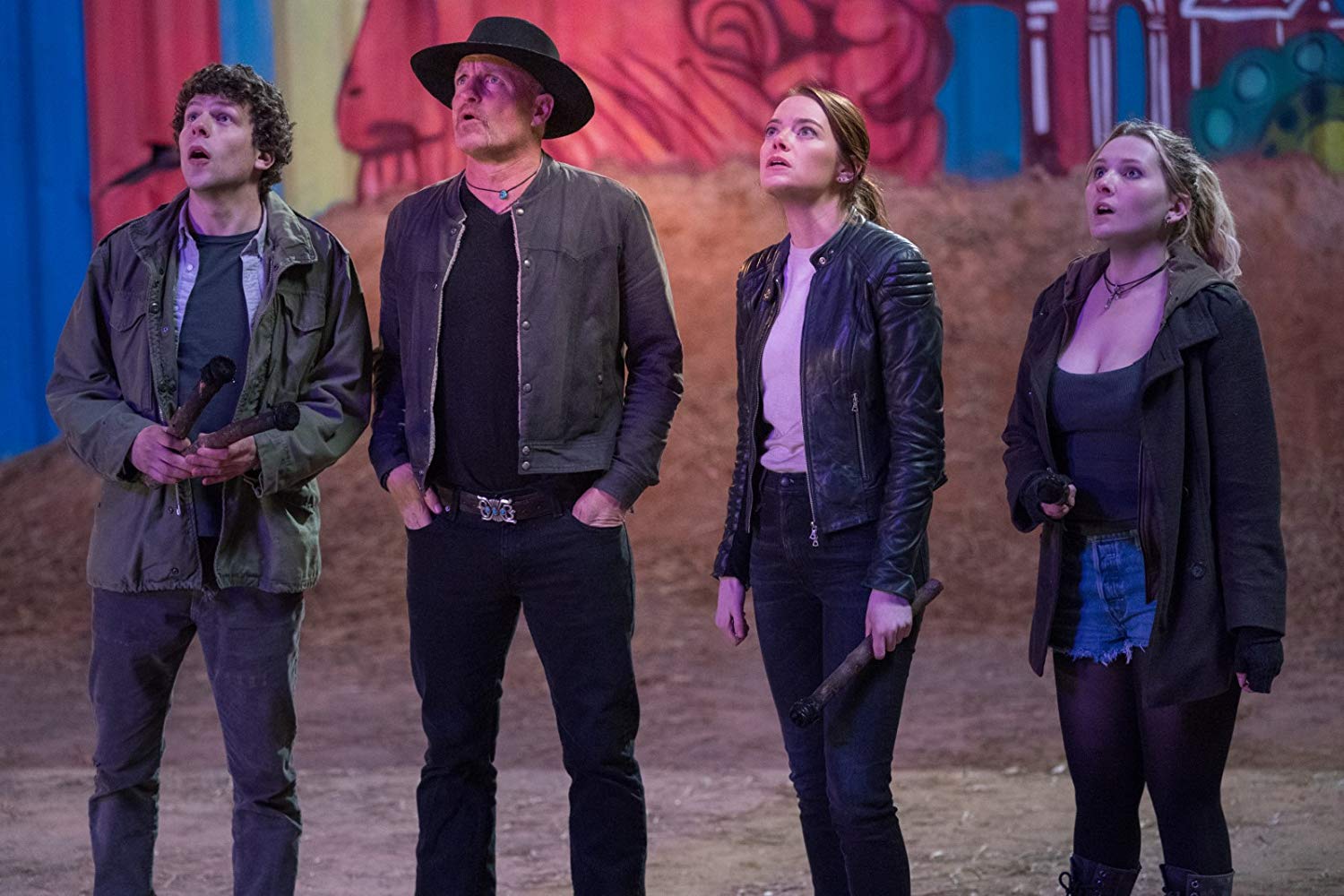
With a comical opening narration by Jesse Eisenberg and a violent and over-the-top zombie massacre scored by Metallicaâs âMaster of Puppets,â âZombieland: Double Tapâ positions itself much the same way as its 2009 predecessor. This is a film, unlike zombie flicks like âWorld War Zâ and âDay of the Deadâ that, while celebrating carnage and gratuitous gore, packs a wholly family vibe, and plays as a PG-13 film, though it is rated âR.â Director Ruben Fleischer returns from the original, and is able to duplicate the humor, surfeit of tongue-in-cheek gore, and camaraderie of the original cast – all who return for this romp. Additional players are of course added; but, with only a bit of lagging pace, âZombieland: Double Tapâ succeeds as being a humorous and honestly worthy sequel.
What separates âDouble Tapâ from its predecessor is its departure from the coming of age story of its motley crew (Columbus, Tallahassee, Wichita, and Little Rock), and a departure from a film that focused more heavily on zombies to tell its story. Here we have a group that is well established. And, like most families, they have their problems. Tallahassee is still misanthropic as ever, questing to go out on his own while feeling obliged to watch over the gaggle of youngins heâs becoming intertwined with. Wichita and Columbus are working to make sense of their romantic entanglement, grappling with the issue of deepening their connection while wondering if their bond is real, or just the result of circumstance. Little Rock is struggling with demons of her own. She wants to meet a guy and start a family. Thinking this impossible as the whole world are zombies, she resigns herself to depression and takes off to find herself.
Of course, âDouble Tapâ has other plans in store and introduces us to a host of human characters, such as a hippie/pot smoking pacifist named Berkley (of course), and a rough, strong survivor named Nevada hiding out in Elvisâ home in Graceland. The former played by Alan Jogia, the latter played by Rosario Dawson, they add to the film in needed ways. Additional players, such as Luke Wilson and Thomas Middleditch add humorous layers to a sequel that must add more players to make it work. However, rather than drag the film down, the additions – sometimes hit or miss – help to cement the humor of the film and highlight the unbreakable camaraderie held by the original four cast mates.
The cast all do a good job here, and you can tell they really enjoy playing these characters. Harrelson is at home here, and it shows. With this, âZombieland,â and his turn as a sarcastic high school teacher in the endearing âThe Edge of Seventeen,â Harrelson shows an actor comfortable with serious material as well as roles that force him to poke fun at himself. Eisenberg is great also, appearing wiser but still naive and trepidatious, quite the departure from his sarcastic and irreverent turn as Mark Zuckerberg in âThe Social Network.â Stone and Breslin likewise follow suit. But if criticisms do come, it’s evident that Stone and Breslin arenât given nearly the depth of of some of the other male characters. Breslin in particular is pushed to act a certain way as required by the plot, without adding a lot of depth for her to work with. She does the best she can with the material.

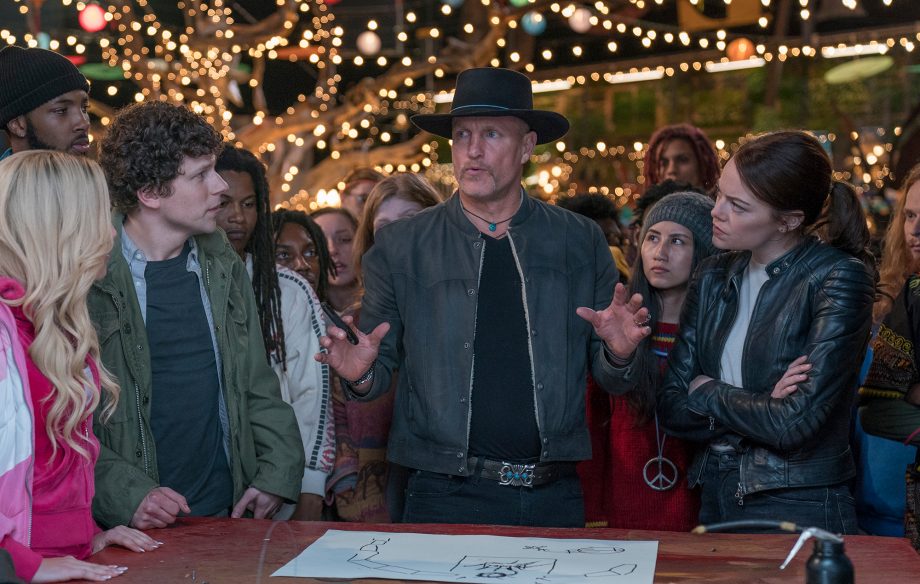
âZombieland: Double Tap,â make no mistake, is predictable as ever, but, somehow, is no less endearing for it. We know there will be a lot of dead zombies, and the film delivers. Additionally we know there will be family bonding and strife between the four main cast; some of these scenes are funny, some are contrived, but overall they work. One hysterical montage of the group taking over the White House, as well as a Christmas, gift-giving exchange, are fun and pleasing, as are others, as when Tallahassee jokes of Little Rockâs new boyfriend that he âdoesnât hate pacifists,â but just wants to punch him in the face. âDouble Tapâ creates a fun father/daughter between Tallahassee and Little Rock, and thanks to their performances, it works.
The film of course takes some crazy turns, such as a host of zombies that are stronger than ever before, fun-loving pokes at Tallahasseeâs manhood, and a road trip to Babylon – a hippie commune where pot is rampant but weapons are banned – that pull the film in and out of reality. But it works. The ending of the film, which threatens to be over the top and cliché, instead is fun, uber-violent, and wholly lovable.
âDouble Tap,â at its base, is just a fun film that presents an experience that recycles what worked about the first film, adds some new, fun elements, and manages to be just as entertaining as its initiation 10 years ago. A fun time at the movies and a pleasing addition to this yearâs â31 Days of Halloween.â
*Note: make sure to stick around after the credits for a post film scene that throws back to the original in clever ways. As funny as âDouble Tapâ is, the post credit clip is worth the price of admission alone, and you wonât regret a second of it.