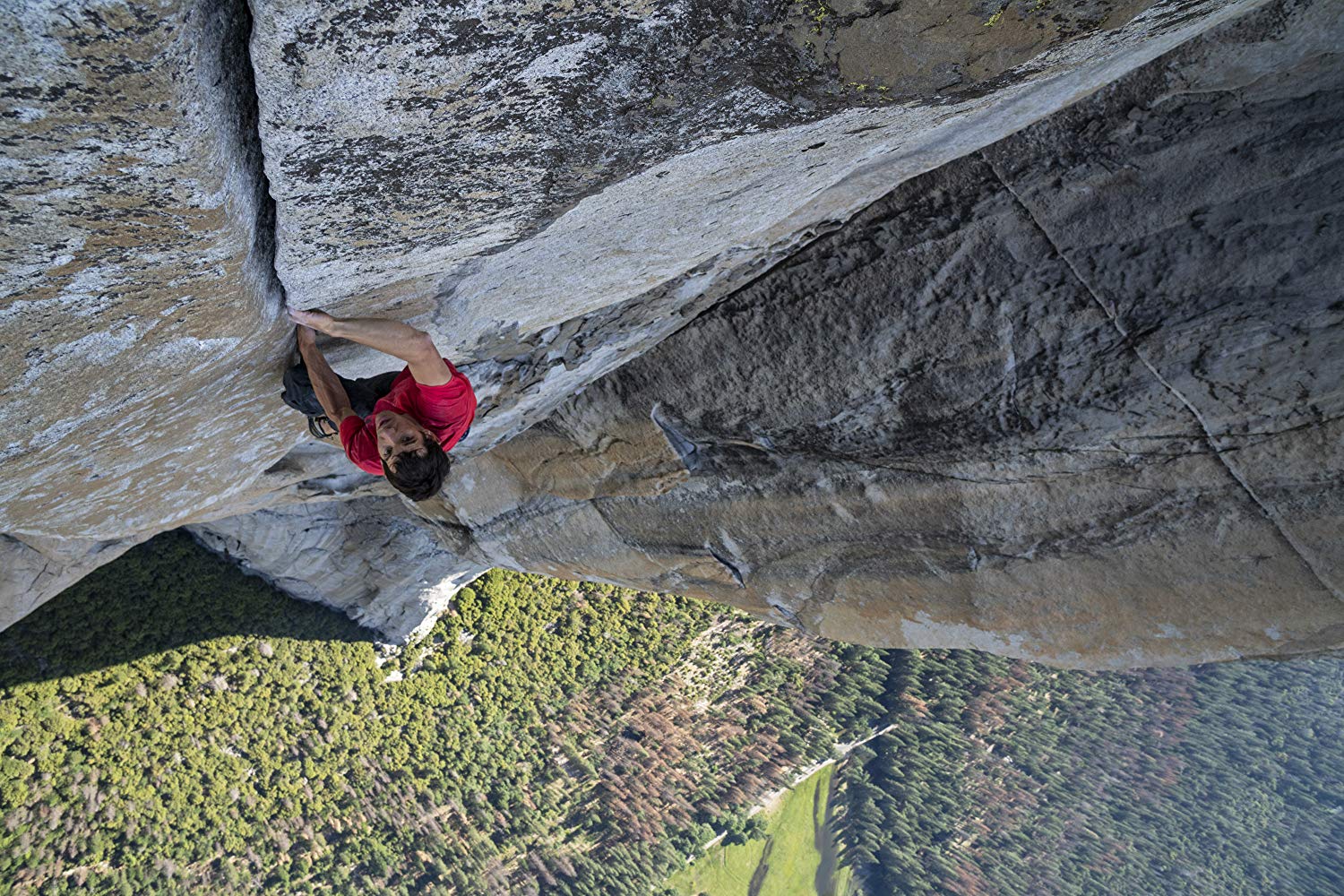
Alex Honnold is a free soloist. To those who donât know what that means, itâs mountain climbing without a rope. For the documentary âFree Solo,â the subject of Alexâs climb is El Capitan in Yosemite Park, a 3,000 ft. sheer rock face. If that sounds insane to you, it is, and this film, directed by filmmakers Jimmy Chin and Elizabeth Chai Vasarhelyi, captures not the climb as adventure (although itâs extremely exciting) but the mindset of Honnold as he trains and contemplates this giant. The film isnât about what ifs – Honnold completed his perilous ascent on June 3, 2017 in under 4 hours, becoming the first person alive to ever free solo the summit. However stupendous this feat, âFree Soloâsâ greatest achievement is that it places you alongside Alex while also allowing understanding into his motives and challenges.Â
As well produced as âFree Soloâ is as a documentary, thereâs something unnerving about it, a palpable fear that runs through it as we watch Honnold attempt his summit. And Honnold, who, after an MRI scan to check him out before the attempt is shown to have an extremely underactive amygdala, or the brainâs fear center, is shown in his solitary world. People around him respect him as a climber (heâs appeared in a litany of climbing magazines) and, as he admits, was lucky enough to have his passion turn into a career. But thereâs something missing from Honnold, both a sense of fear of his own risk and a lack of empathy towards those who love him and fear for him that âFree Soloâ is expert at capturing in full. I donât believe Shin or Vasarhelyi did anything special to capture this; they simply point the camera at the free soloist, let him talk, and we instantly get it.Â
Shin and Vasarhelyi let us know pretty early in how dangerous this profession is. We see one of Honnoldâs climbing buddies make the assertion that âanyone who makes free soloing a full-time effort dies.â You can let that sink in. Itâs a terrifying concept (as is, Iâm sure, dangling from a mountain with nothing but chalk and a grip from thousands of feet in the air); but we get the impression that Honnold, who is every bit aware of the possible end game, doesnât really get it. Heâs extremely focused, for every step and handhold can lead to his death, but itâs a clinical level he grasps it on, not an emotional one. His girlfriend, Sanni McCandless, discovers this as well in a conversation about the risks and if he would stop free soloing to commit to their relationship. âI understand where youâre coming from,â he replies as theyâve rehearsed to work on his communication in the relationship. âBut I donât feel obligated.â
Alex is an encyclopedia of climbing knowledge. He will admit fear over the various difficult âpitchesâ of the mountain (stages he must go through to finish the climb), and talks about completing this handhold here, this leg stretch there, this mini jumpâ¦all without regard to the consequence of what will happen if he misses one of these feats. He seems invincible; but we see that after a fall during a practice climb that leads to a broken ankle (a fall which Alex canât recall the details of), that one mistake on the mountain can lead to instant death.Â

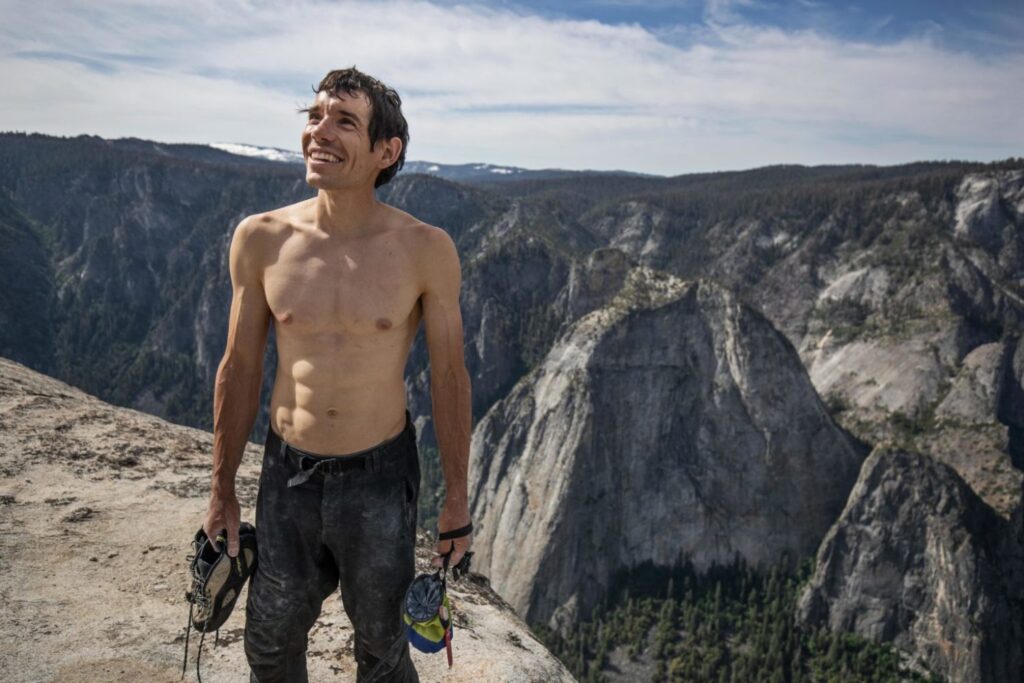
What the documentary does well is to make the film about his preparation more than his summit; so much so that the actual climb is reserved for the last 15 minutes of screen-time, often with speed throughs of a chalked path to denote his progress. Shin and Vasarhelyi shine the camera on Honnoldâs life, and instantly draw us in. Without giving much away, we learn about his childhood, his parents, his adolescence. Little in the way exists for Honnoldâs motivation for climbing apart from an awkward childhood and a lack of parental love.
With an almost clinical narration, Honnold explains no one in his family hugged him or said âI love youâ and he had to âteach himself to hugâ at the age of 23. His relationship with his girlfriend is a mirror for this. To climb a mountain without ropes requires a steel will and clinical focus. He doesnât think like a couple during his climb, doesnât think what he could lose if he fails. But to think of someone else, to let this armor down, could lead to instant death. His defense mechanisms are one and the same with his continued existence.Â
If it sounds like âFree Soloâ is less the exciting climbing film you might be hoping for, and more an exercise in psychology and patience, youâd be right. This film doesnât make free soloing look sexy, but dangerous, and you truly get the impression that Honnold is on borrowed time. The cinematography highlights this, showing perilous perches, mini falls on ropes during trainings, and thousand foot cliffs with smooth surfaces with little to grab onto. In Honnoldâs most aggressive manuever he âkarate kicksâ the wall with his left foot while holding onto a handhold with a thumb and two fingers. The sense of vertigo is palpable; though Shin and Vasarhelyi spare us from prolonged senses of this with interviews and background story throughout.Â
âFree Soloâ is an achievement of a film. It completely brings you into the picture and into Honnoldâs world. Heâs idiosyncratic and intense, but the film normalizes him and makes him someone you can understand and relate to. Also, perhaps unknowingly, the film give viewers a sense of extreme accomplishment and wonder. Watching Honnold make the final summit youâll want to clap – although his desire to experience âmomentary perfectionâ will surely lead him to climb again, erasing much of the relief we may feel. Honnold lives an intense and mystifying life. The film ends, much like it began, with a spotlight on his nature. After completing the climb and reuniting with his girlfriend, Honnold closes the film by practicing finger holds from the door of his van. A sense of accomplishment and drive pushes this film towards wonder – but its subjectâs psychology, which it captures perfectly and without error – is what drives it to perfection.