





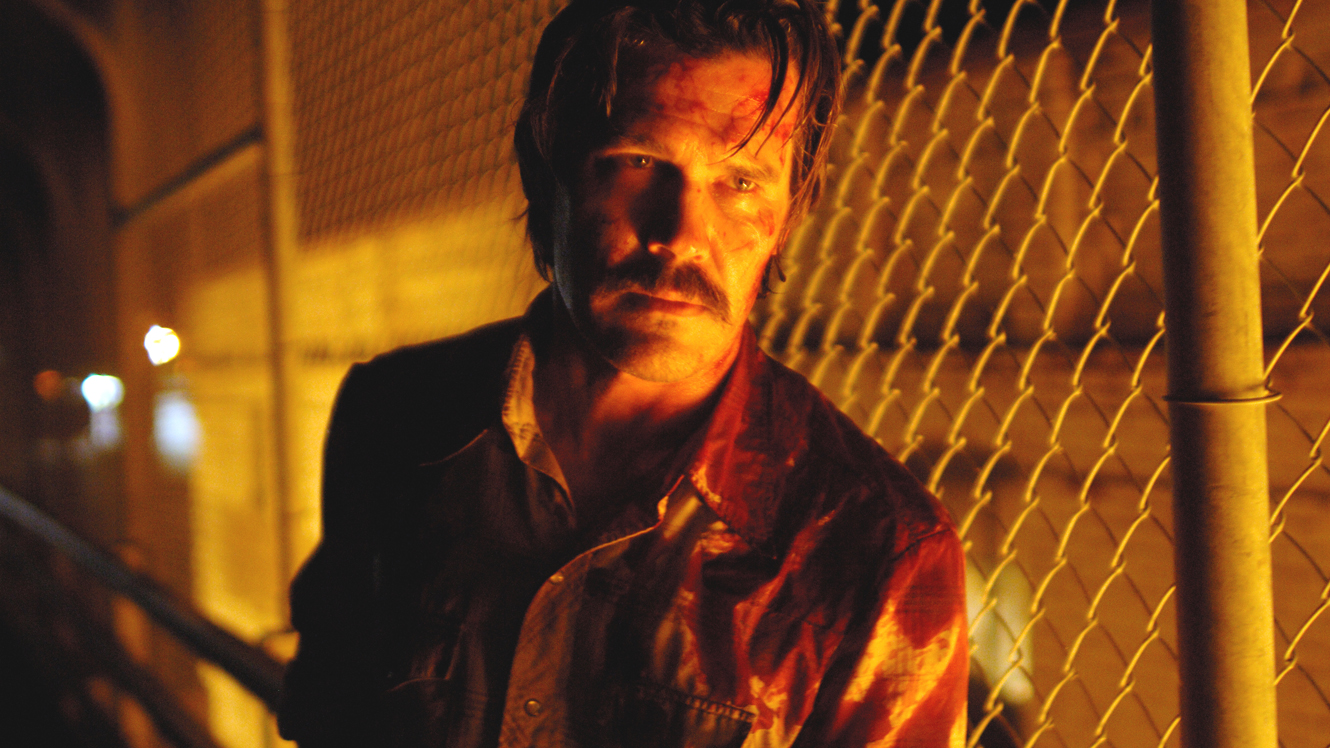
âNo Country For Old Men,â like âFargo,â âReservoir Dogs,â and like dramas, paints a crime, the opportunists seeking to take advantage of it, and a retribution seen as a force of nature – or, more simply, inevitability. Directed by the Coen Brothers (and snagging a âBest Pictureâ Oscar at the 2008 Academy Awards), the film revisits themes present in their earlier work while layering the story between three men. Taking place in a West Texas town, itâs a film absent of morals, but full of vision. Its third act, while bizarre, leads you down a path to its dreamlike and unavoidable conclusion.Â
The film is a concert of cinematography and acting elevated to a degree as to become superlative. Weâve seen Joel and Ethan Coen do this before – such as in the aforementioned âFargoâ – yet here is stripped down to a smaller cast and amplified. We have the law, Sheriff Ed Tom (Tommy Lee Jones) who opens the film with a monologue about the changing times. His grandfather was a sheriff, never carried a gun, and Ed Tom wonders how he would do in todayâs world. We see Ed Tom is true to his word: along a hunt that spans most of the film, he pulls his gun only once, in a scene at a strip motel that is as carefully crafted as it is tense.Â
Ed Tom is set against two other men: one, a retired welder named Llewelyn Moss (Josh Brolin), and the other, a ghostlike killer named Anton Chigurh, played by Javier Bardem in a performance that won him an Oscar for âBest Actor in a Supporting Role.â The film opens simply, with Moss, while hunting, stumbling across the aftermath of a shootout in the desert and a briefcase containing $2 million. Thinking he could take it without consequence was a mistake. Doing so sets loose Chigurh on him. The ensuing cat-and-mouse game between them occurs as an end upon itself. Llewelyn represents opportunity, Chigurh consequence, and Ed Tom as a rational man who tries to make sense out of the situation and fails.Â


Itâs here that I feel the Academy dropped the ball in failing to acknowledge Brolin for his performance. Sandwiched between Lee Jones and Bardem, he becomes an integral part of the film. Brolin is a talented actor and has turned in great performances before, as in Dennis Villaneuveâs âSicario.â However, here he does possibly the best work Iâve seen. Heâs foolish, yet smart, industrious, and stubborn. He has a simple relationship with his wife (Kelly Macdonald) whom he sends away when he realizes heâs in danger. Heâs retired and she works at Wal-Mart. The $2 million represents a bigger life; though you get the impression even Moss doesnât believe heâll get to enjoy it.Â
The script is detailed and precise, and Bardem performs as though he were made for the role. He sports a peculiar haircut, and walks around with an oxygen tank that doubles as a cattle gun and carries a shotgun and silencer that are longer than his body. He performs kills, he intimidates, he threatens, all while remaining under detection. âHeâs like a ghost,â Lee Jones remarks in one scene to a fellow officer. We donât disagree.


It takes more than acting and cinematography to make a film, and the Coens know it. Of course, both are superb, a credit to the cast and Roger Deakins, the Director of Photography. But âNo Country For Old Menâ is blended elegantly with its camera shots and its score, done by Carter Burwell, known for the âTwilightâ saga, among other things. It also blends the morals of its characters with the screenplay to finesse. Ed Tom in particular struggles to accept the events of what is happening in his small town. He acts with deference toward these events, knows what is in store for Moss, yet attempts to help him anyway. Ed Tom wants to quit. The times are changing and he feels ill prepared for them. In a way, heâs right. âYou canât stop whatâs coming,â one character advises. âIt ainât all waiting on you. Thatâs vanity.âÂ
In a way, âNo Country for Old Menâ is as illusory as its antagonist. It represents events that begin and end, and treats them with a sense of finality. Chigurh is a force of nature. Had Moss not taken that briefcase, heâd still exist, only we wouldnât see him. But Moss did take the case, and because of it unleashed a set of events that play out in a tense, inviting, and inevitable fashion. A warning: âNo Country for Old Menâ is a introspective film, its body contained in unclear scenes with unclear motives. If youâre looking for a straightforward narrative, you may be disappointed. But by and by this is a well-made and engaging film that is one of the Coensâ best.Â
– by Mark Ziobro


