






Watch any boxing picture from the last two decades and try not to notice the inspirations drawn from âRocky.â The down-and-out fighterâ¦the hard on his luck, once great contender now reduced to povertyâ¦the man (or woman, in âMillion Dollar Babyâsâ case) that risks it all for a shot at greatness. The motif is familiar; but seldom has it been done with such class, such focus, and with such grace than in 1976âs âRockyââdirected by John G. Avildsen and written by Stallone himself.Â
Remarkable is the fact that Stalloneâstruggling financiallyâwrote the screenplay for âRockyâ in three and a half days, inspired after watching the Muhammad Ali/Chuck Wepner fight. Stalloneâs condition for the sale of the screenplay was simpleâhe must play Rocky. He had but hundreds in his bank account at the time. 42 years later, and the film has grossed over $200M worldwide.Â
âRockyâ is, above all else, a character piece, a story of a man who got his shot, took it, and learned to believe in himself along the way. Truthfully, the fight scenes in the movie amount to probably 15 minutes of screen-time. The real action, the meat of the movie, lays in-between.Â
âRockyâ opens with a small club fight. He wins the fight. The loser wins $40 minus club fees, leaving him $17 to take home. Rocky Balboa, the winner, makes about $65, and doesnât take home that much more. Rockyâs been grinding out a living for some time. He has a friend Paulie (Burt Young) who works as a meat packer. Paulie has a shy, sheltered sister, Adrian (Talia Shire), whom Rocky is in love with. And he has a standoffish relationship with his former boxing trainer Mickey (Burgess Meredith), who we see has long since given up Balboa as a lost cause.

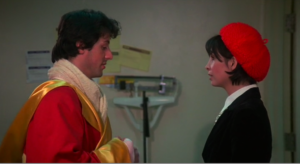
Not making it as a boxer, Rocky spends his spare time roughing up goons for a low level loan shark (Joe Spinell). âItâs a living,â he says, even though we glean he doesnât like it. âHeâs good for it,â Rocky states in defense as to why he didnât break a manâs thumb as asked. Â
Itâs in this way that the film sets up its characters. Balboa is caught between two worldsânot successful enough to be a famous boxer, but having not yet resigned himself to honest work. âYou could have been a contender!â Mickey yells at him in one difficult scene. But itâs not until he sees the world champion on television, a boxer named Apollo Creed (Carl Weathers), that he understands what this truly means. Accepting your lot in life makes sense to the people in Rockyâs small circle; taking a shot is an illusory and foreign concept, whispered but never realized.Â
We know the story from here. Creed, in an attempt to draw crowds and publicity, offers to fight one of Philadelphiaâs underdogs for the title. In a fit of luck, that underdog becomes Rocky. Creed uses the opportunity for cocky declarations of his prowess and cheap shots at Rockyâs expense. âIt doesnât bother me,â Rocky protests. Only in a later scene between Rocky and Adrian, that is touching and real, do we see that it does.
The cinematography suits the film well. Scenes of blue collar existence are interspersed with the larger than life success represented by Apollo Creed. Philadelphia is shown in murky gloom, even amidst the famed shot of Stallone atop the âRocky steps.â Thereâre some other dramatic shots too, such as a pan down to the words âresurrectionâ as Balboa fights in the opening shot, and the filmâs best, as Rocky visits the empty arena the night before the fight, looking up at his poster with humility and fear.

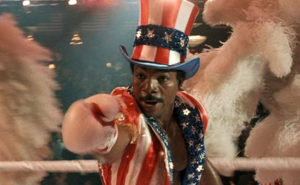
The performances are all aptâfrom Shire, to Young, to Weathers and Burgessâbut the real gem is Stallone, who gives Rocky a heartbeat and likability. Thereâs pain in Rocky; but Stallone creates a character that exists despite it, one that lets it drive him but never take him over. Rockyâs real, and I canât imagine the picture being the same without the everyman persona Stallone brings to the role.Â
This is helped by interactions with all involved. To Mickey, heâs his last chance to shine as a manager, to Adrian, heâs love. His relationship with Paulie, an often angry drunk, is more complex. He wants out of his low caste existence and views Adrian as an anchor around his foot. He wants Rocky to rise, but then systematically resents him for it. Itâs a simple thing that placates him, we seeâRocky agrees to wear an advertisement for Paulieâs meat packing plant on his boxing robe. âHe gets to make some money, I get to keep the robe,â Rocky shrugs.Â
Everybody knows how âRockyâ ends. Its legacy is imitated by countless films, such as âCinderella Man,â “Southpaw,” and even the robot boxing film âReal Steel.â But unlike those films, âRockyâ isnât a rise, fall, then rise again picture. Rocky was a ghost, a nothingâbut he finds something within himself he thought he never had.

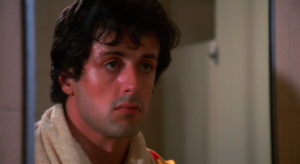
âIt doesnât matter who wins this fight,â Rocky narrates. âIf that bell rings and Iâm still standing, Iâm going to know for the first time in my life that I werenât just another bum from the neighborhood.â
At âRockyâsâ conclusion, Balboa is not a bum. Paulie knows it, Adrian knows it, Mickey knows it. We know it too; weâve known it all along. But now Rocky knows it too. The strength of this picture lies in that revelation. Rocky always had it in him to be a contender. He just needed to believe in himself. A stellar story, coupled with unforgettable performances, allows him to do just that.Â


2 Comments
Great review and nice work snapping into focus the real point of the story, that Rocky found out he wasn’t a bum. Great and inspirational. But what about those of us that are bums? Rocky had the talent to become a contender. Most people don’t have that talent. Rocky got a few lucky breaks that allowed him to find success. Most of us don’t get those breaks. Rocky found a support team of losers in Mickey, Adrian, and Paulie, that allowed him to succeed. Most of us don’t ever find that. Most of us are average. Average luck, average intelligence, average talent, average ambition, average drive. Many of us are even less fortunate than that. Most of us will never find anything like success, and many of us have no chance. A real part of life is learning to accept that, no, you’re not as smart as you’d like to be and there are many people way smarter. No, you’re not really good looking, you’ll never turn heads. And no, your parents didn’t support your ambitions and you didn’t get enough lucky breaks. Isn’t that ok?
Larry, thanks for the comment. I get what youâre saying, especially about those of us that donât have an innate âtalentâ like Rocky. None of us are bums, no matter how âaverageâ we are, and we all have worth. I would argue Rockyâs boxing talent was a storytelling tool of showing how a man who had given up on himself found his worth. Itâs translatable to us all. Wether youâre a an athlete, a doctor, or just someone who goes out of his or her way to help others in need, that worth is worth discovering. But you bring up a lot of good points about poverty and lack of chances. Paulie is a perfect example; heâs a tough character to root for sometimes, but by simply being able to advertise on Rockyâs robe he found a purpose to be something better. We all have it, and no one knows what we might need until we find it.