





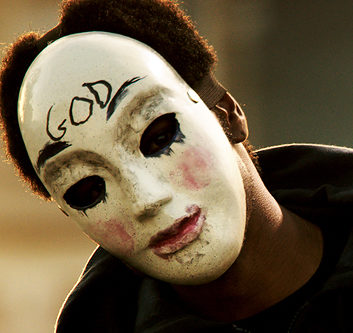
After last yearâs âThe Purgeâ disappointment, my expectations were virtually non-existent for âThe Purge: Anarchy.â The quick production of the sequel also contributed to my low expectations, because I appreciate a strong production value.
The film opens with three different chapters that intersect within the first 30 minutes. The first chapter is an average working mother Eva Sanchez (Carmen Ejogo), and her daughter Cali (Zoë Soul). They represent the lower-class citizens, and theyâre forced out onto the streets when a small army infiltrates their urban apartment building. Another chapter follows a police sergeant (Frank Grillo), who is out on purge night on his own accord, searching for vengeance. The third follows a middle-class couple (Liz and Shane, Kiele Sanchez and Zac Gilford respectively) whose car breaks down on the highway in downtown Los Angeles. When all of these characters intersect, a simplistic A to B plot is introduced.
Writer/Director James DeMonaco improves on the original in a lot of ways. Most notably, the high concept works better as an ultra-violent action flick, and the originalâs horror aspirations just made it weaker. With a decreased amount of pop-up scares, this seems to aspire to be an action film with horror undertones â as it would be freaking scary to be out on purge night. Itâs a high-concept from the mind of DeMonaco, where each year, crimes â including murder â are completely legal for twelve hours. Of course, you canât use weapons over Level 4 (rocket launchers would be out of the question), and you wonât legally be able to assassinate the President.
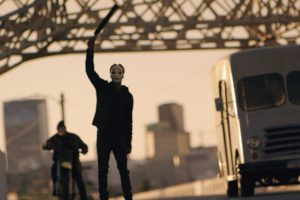

The idea is designed to render the crime rate non-existent and to lower the unemployment rate. Itâs a way for Americans to let off steam, or to ârelease the beast,â a right they are given by the new founding fathers of 2023. Itâs also a way for the corrupt government to allow the murdering hunters to thin the herd by killing those who cannot defend themselves â the homeless and the poor. Itâs also a way to control the American population, like hunters do to control the animal population. Itâs also another way for Americans to be number one in lowest unemployment rate and lowest crime rate.
One unbelievable aspect is that people still wonât be imprisoned on non-purge day. I donât buy that there still wonât be money laundering or bank robberies. One thing that DeMonaco failed to take into consideration is the desperation of humans; because if theyâre desperate enough, theyâll still steal or rape. Especially if theyâre mentally ill, theyâll probably still kill because they could just snap. Even if they do wait until purge day, itâs just not logical â because the justice system is what would be keeping that anger, or crazy urge to kill someone, in line.
Never-mind oneâs morals or anything. Thereâs a bit of a more moral argument brought into this film through certain characters. One is a young woman named Cali (Zoë Soul) who is fascinated by an activistâs beliefs in the immorality of The Purge. This man, Carmelo Johns (a great Michael K. Williams), wants to fight back â because itâs legal, baby! Caliâs brief lectures to another character about the immorality of The Purge makes it a bit more in your face than it should have been in an average horror movie, but it adds a layer that the original was missing.


The film has good pacing and a strong third act. The characters are underdeveloped, but thatâs fine with everything else going on. Since DeMonaco brings his story onto the streets of the purge night, it has much more depth and possibility of events than the first had, which was a limited home-invasion thriller with long stretches of yawn-worthy cinema. He knows where to improve and thatâs great for a young filmmaker. Perhaps I enjoyed this because my expectations were non-existent, but if this is the direction the low-budget franchise is headed, itâs looking pretty good.
– by Daniel Prinn


