






Purposeful films are often harder to view, or critique, than films of chronology or substance. This is especially true with revenge films. Quentin Tarantinoâs âKill Billâ is an example of a good film that uses revenge as its motive and camera shots, violence, and exposition to tell its story. The 2010 reboot âI Spit on Your Graveâ is an example of a bad film, a movie that uses its violence not as art, but as evidence of a world devoid of innocence and decency in which we should find pleasure in rapists being brutalized in equal measure to their victims.
Nicholas Winding Refnâs “Only God Forgives” has more in common with the former; itâs beautifully shot, and beautifully scored. Unfortunately, the film sells its exposition for its gorgeous style, and is infused with bloody violence and a lack of morals that comes off as little more than bitter desperation.
Revenge in Underworld Bangkok
The setting for the film is Bangkok, and tells the story of Billy (Tom Burke) and Julian (Ryan Gosling), two American brothers who are drug dealers in the criminal underworld and run an underground boxing ring. The filmâs description portrays it as a tale of brotherly love and revenge; however, we quickly see things are not so black and white. In quick sequence Billy rapes and murders a 16-year-old prostitute, and is captured by a ruthless detective (Vithaya Pansringarm) who entices the girlâs father to murder Billy before cutting off the manâs hand as a warning to protect his remaining children. Julian questions the man for his motive and lets him go. However, it isnât long before Julianâs unforgiving mother Crystal (an excellent Kristin Scott Thomas) arrives with her eyes set upon the revenge Julian is seemingly ill equipped to exact.
What âOnly God Forgivesâ has going for it is convincing acting and an eerie filming style, courtesy of cinematographer Larry Smith. Itâs clear Refn and Smith have infused a Kubrickian style into this film, from shots of long, abandoned corridors reminiscent of The Overlook Hotel in “The Shining” to the dramatic and haunting score of classical organs and modern synthesizers that practically exudes Kubrickâs swan song, âEyes Wide Shut.â The movie is cloaked in darkness and highlighted with oranges, reds, and neons. The effect is singular and captivating, presenting a milieu that subtly begs our attention.
Limited Dialogue in Favor of Artistry
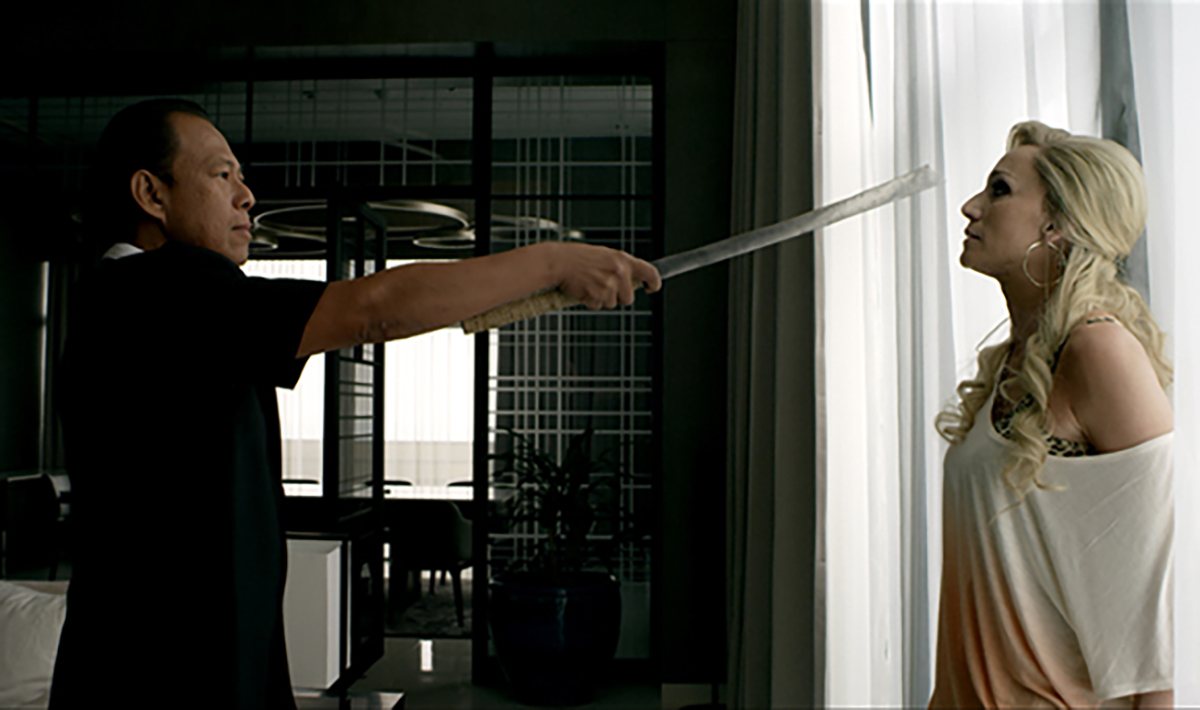
The filmâs dialogue is limited, however, used at times to make attempts at profound meaning, while other times for little more than to shock or offend. Early scenes between the ruthless Chang and his 4-year-old daughter are poignant as the man hints that violence is the only way to control others, while she innocently implies polite discussion can achieve harmony. However, later scenes are less effective, and are at times overly prosaic or purposefully crass.
The worst offender of this is Julianâs mother. To a young girl working the front desk of a hotel she bleeds intolerance and entitlement with speech that belies a woman used to getting what she wants often before she asks. However later scenes are just purposefully cruel, as she emasculates Julian at dinner, cutting him down with remarks better suited a bitter enemy than her own son. In response to why he tolerates the abuse Julian remarks only, âSheâs my mother,â blurring the edges of reality even further. Thereâs a past between Julian and Crystal lurking in the shadows of this film, but it seems Refn wants us only to be shocked and offended by their relationship rather than to understand.
Beautiful Shots but Confusing Narratives
The biggest problem with âOnly God Forgivesâ lies in the increasing impossibility to sympathize with any of the characters. The theme of a motherâs love is certainly understandable â but this wanes considerably as we realize Billy is a complete scoundrel devoid of morals. In fact, there are only two men in the film who bat an eyelid at the passing of the murdered girl â Julian, who refuses to kill his brotherâs murderer when he finds out what he did, and Chang. However, the film doesnât mean to remark on the terribleness of this girlâs death, but only on the nature of revenge. Both Chang and Crystal work their way through the guilty parties, culminating with an anticlimactic fist fight between Chang and Julian that ends in a head scratching way.

Additionally, âOnly God Forgivesâ joins a legion of films of late that insist on telling their stories with an overreliance on brutality or gore. Billyâs murder is handled in glossed over way, while far less vile characters in the film are brutalized in tasteless fashion. Just as âI Spit on Your Graveâsâ murders are meant to be an endurance test, Changâs torture of a luckless criminal (involving bamboo hair pins, chains, and knives) in âOnly God Forgivesâ runs the same test. If the film means to impart the message that revenge is not justice, it would have been better served ending with Chang and Julianâs unfulfilling boxing match rather than the way it does end, a significant amount of time later with little else added to the narrative. The film is somehow overlong at only 90 minutes, the result of its visual exposition and often-dreamlike progression.
A Hard Film to Critique
At the end of the day, âOnly God Forgivesâ is a difficult film to review. The film is purposeful, its shots beautiful, and its acting brilliant. However, its characters are so unlikeable that many viewers will be left with a big ‘who cares?’ at the movieâs conclusion. This is the kind of film that will be revered for its style, lighting, and soundtrack, a result that will alienate many looking for an underlying moral, which never becomes apparent. With more character development and dialogue, and less self-congratulatory brutality, âOnly God Forgivesâ could have made a definitive statement. Perhaps its strongest failure lies in the fact that it could have been more.



1 Comment
I think you miss the point of the film . It’s a beautiful revenge tale nothing more nothing less.