





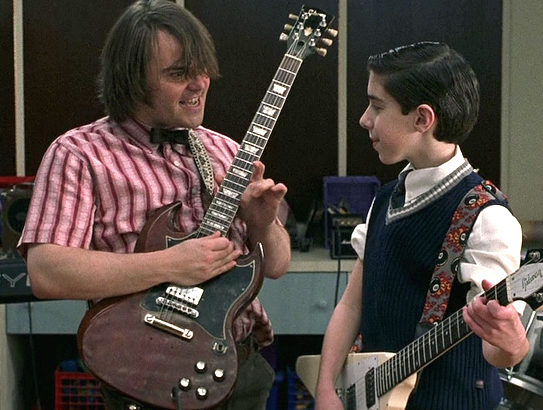
When you think of a hopeless romantic, you donât think of Jack Black. And you certainly wouldnât think of Dewey Finn, who Black portrays in “School of Rock” with stubborn tenacity, as an underdog even worth rooting for. However, if ever there were a hopeless romantic, or a would-be-loser you want to succeed more, youâd be hard pressed to find a better movie, or a better character, to root for.
Jack Black plays the rocker, and loser who, at the beginning of the movie is down and certainly out. He is kicked out of the band that he formed for not taking the band âserious enough,â by his band mates who want to go on to win that springâs âBattle of the Bands.â Dewey likes to rock. He likes âface meltingâ solos and stage diving. However, as he dives off the stage during an act he is left to hit the floor by a group of unimpressed fans. âNobody caught me. That was lame,â he mutters in shame.
He is also in bad financial shape, which his roommate and ex band mate (Adam Pascal), with a new girlfriend to impress, is growing tired of supporting. His dream is to be a successful rocker…however, everyone in his life thinks heâs a loser, and with no band and no money, it doesn’t seem that this dream has any chance of coming true.
However, this movie is about the powerful transformation of rock according to Dewey: A power that has the ability to melt the hardest hearts with its melody, and even possibly enough power to give a hopeless loser another chance. A chance phone call asking for his roommate to substitute teach at a posh prep elementary school gives Dewey the chance to earn some money in a simple and underhanded way– he pretends to be a teacher.

Showing up at Horace Green Elementary, it is clear that Dewey has no experience at teaching and his class of 10-year-olds quickly sees through him. He begins his lesson by explaining what a hangover is, and proceeds to dedicate the rest of class to ârecess,â ignoring one studentâs quip about his problem with alcohol. âIt means youâre drunk,â the student accuses. Deweyâs response: âNo, it means I was drunk yesterday.â The studentâs understanding of the situation, however, goes far beyond a naïve understanding of alcoholism and sets the stage for an intelligent movie that stimulates its audience rather than placating them with glossed over jokes and tired one-liners.
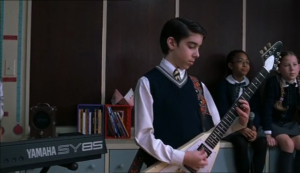
Clearly struggling with his newfound position, Dewey, gets his big break when he hears his class during their music lesson. Peeking through the window he sees the shy kid in the front row ripping classical solos, the quite girl on the other side of the room mastering the cello, and an awkward Asian child dominating the piano. The chord is struck within him and his goal is clear before him: to take his class of educational over-achievers and turn them into a killer rock band.
Make no mistake, that this is a feel-good family movie, and bends, if not breaks most of the rules of realism. While Deweyâs aim to win the âBattle of the Bandsâ with his new-found trove are anything but selfless, in his assignment of band members and positions his charm begins to shine. He hands the classical guitarist an electric guitar and finds out he can truly rock; he puts the Asian kid behind an electric organ and is blown away by his talent. He also finds out the cellist can do just as well at the bass guitar, and Frankie, who challenged his drinking in the opening scene, can really drum. In fact, he finds a position in the band for everyone in the class…some lighting and effect technicians, some fashion designers, some backup singers, and even knights one spunky girl âSummer,â who sees through him the easiest, to âBand Manager,â which, sweetly, seems to appease her.
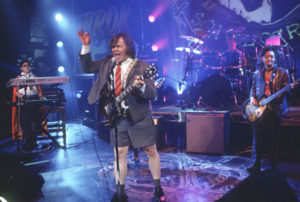

Another high point of the movie, in addition to providing laughs and genuine gladness on the part of the classâ accomplishments, is its complete lack of naivety. Some problems, such as one studentâs over-protective, controlling dad, donât have an easy solution, but arenât glossed over – and, thankfully, arenât accepted or encouraged, either. And while the movie has its theatrics (such as a grand finale in front of the âBattle of the Bands,â) itâs more powerful to see Dewey actually become these kidsâ teacher, if not in credentials then in heart. When he tells one girl not to be ashamed of her weight – because music has the power to overcome even this – you find yourself wishing that he were right. âYou know who else has a weight problem…me,â he says. His response when she asks him why he doesnât go on a diet shows more keen insight and self-actualization than the movie probably intended…âBecause I like to eat.”


Aside from Blackâs performance – which is the best I have ever seen him – great acting from all childreninvolved, as well as the schoolâs reluctant Head Master played by Joan Cusack, will warm your heart. The finale (not to ruined for those who havenât seen the movie) is akin to Rocky both in homage and in scope. The emotions are real, and, honestly, the movie gives audiences possibly everything they could want going in and more.
Going into this movie is a decision. Maybe there was nothing else on television and you just happened to catch it. Perhaps youâre amused by Jack Black and didn’t see any harm in giving the movie a chance. And even if you think heâs a foolish comedian and donât really see the point…youâd be hard pressed not to reach the end of this movie and not think you were better for it. Youâll smile, youâll laugh. And if nothing else, âSchool of Rockâ will give you, if for less than two hours, a dose of the magical, transformative, healing power of âRock ân Roll.â
– by Mark Ziobro


