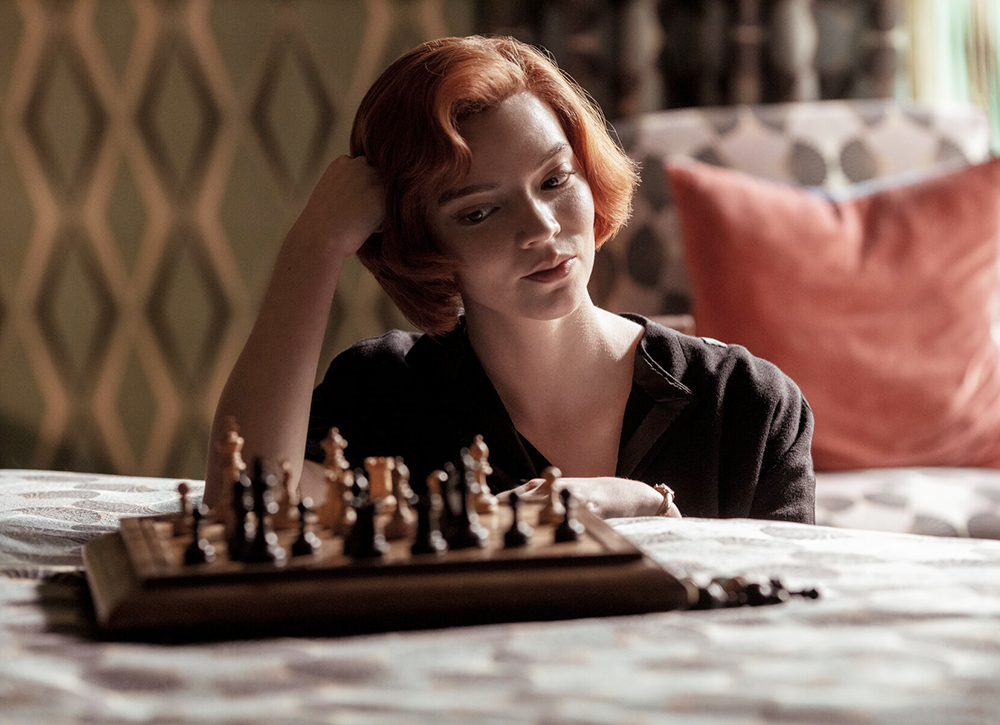
âThe Queenâs Gambit,â a 7-part Netflix mini-series, is about hardship, itâs about overcoming adversity, itâs a period piece, a sports âmovie,â and a treatise on self-love and redemption that creators Scott Frank and Allan Scott wrap up into an orphaned girl growing up in the 1960s who just happens to be, of all things, a chess prodigy. The show is a wonder, not only for making the game of chess seem thrillingâand at times sexyâ,but taking you alongside the journey of its lead, a journey that feels complete from beginning to end. And, apart from all that, âThe Queenâs Gambitâ is just a feel-good story that actually makes you work hard to feel good. This is not a piece of emotional manipulation, but storytelling, acting, and set-crafting of superlative design.
The particulars of the mini-seriesâ backstoryânamely that its protagonist, Elizabeth Harmon (Anya Taylor-Joy), was actually based on several chess prodigies such as Robert Fischer, Boris Spassky, and Anatoly Karpovâas written in a novel by the same name by Walter Tevisâshouldnât be relevant. And, given the showâs massive appeal (it garnered a 97% Tomatometer score on the aggregate site âRotten Tomatoesâ and a nearly identical 95% audience score on the same platform), its strengths lie in its emotional portrayal of a talented, strong, but weary lead who finds her way, and our consequent emotional connection to a character in a way Iâve not seen on a TV series in quite some time.

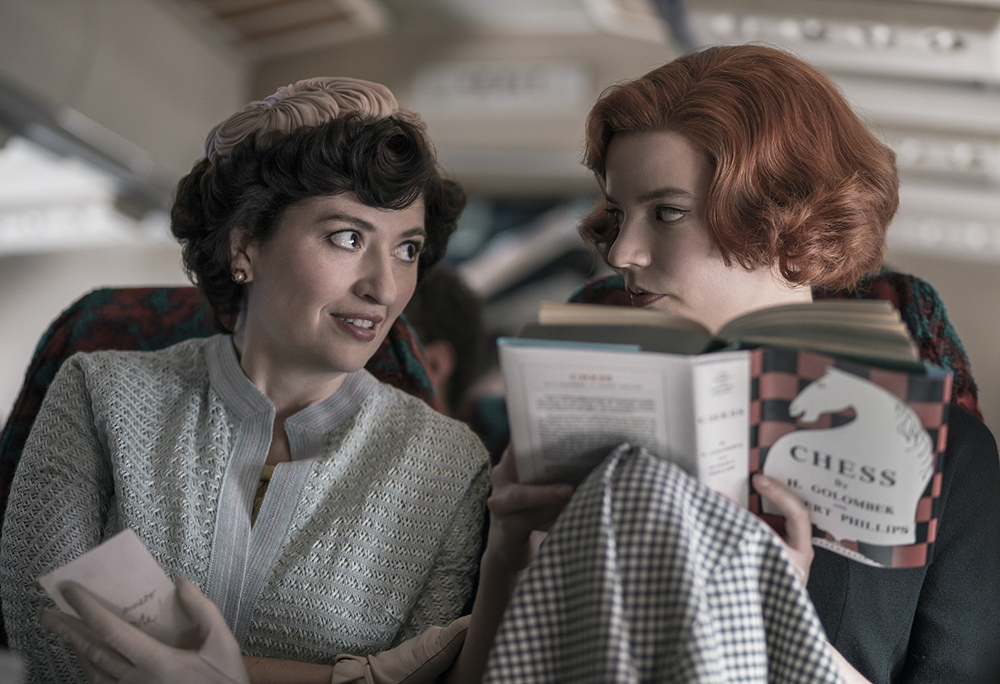
But, under it all, âThe Queenâs Gambitâ is a period pieceâand a superb one at that. Starting out, we meet Beth Harmon (Isla Johnston as a child; Taylor-Joy as an adult) as she is placed in an orphanage for girls following her motherâs death in a tragic circumstance. Sheâs lost and alone; but it is here she discovers three things that will shape her for years to come: a best friend, Jolene (Moses Ingram), a love for chess after discovering the game with the orphanageâs caretaker Mr. Shaibel (Bill Camp), and an addiction to tranquilizers the State gave to children until they are abruptly cut off. All three are handled in a believable and captivating way; Beth, an odd duck of a character immediately begs our attention. Through her silent, cautious, yet unabashed bravery, we are immediately struck with a character we grow to care for. Isla Johnston imbues all the trepidations a child of only eight would feel after being abandoned by those who were meant to protect her; Taylor-Joy all the eagerness of a young woman of 14 who is ready to break out and experience life.
Bethâs subsequent coming-of-age in small town Kentucky is a filled with adventure as she learns the ins and outs of newfound family life (Marielle Heller, who plays Bethâs adoptive mother Alma Wheatley, deserves an award for one of most warm, real, and endearing supporting characters of this past year, bar none) while discovering a penchant for chess that belies her young age. Beth has a gift: she can see the pieces in her head, can see every move possible by both playersâ¦but as we see it comes with a cost. Her gift is only present first with the aid of the little green tranquilizers she had become accustomed to at the orphanage, and later with the aid of booze.
Beth attends her first chess tournament at the local school; she has never played professionally, but mops the floor with everyone there, from talented beginners to a man (Harry Melling) one step away from Grandmaster. During play she excuses herself to the bathroom and has her first period, aided by a female player she had beaten just before. Scott and Frankâs vision is deft, subtle, and captivating: chess is Bethâs family; she grows up and heals inside its 64 squares and fixation to logic; and finds, truly, her family.
The acting in the series is bar none. Taylor-Joy is a wonder to behold. She is strong and determined, despite coming off at times as cold and rude. But itâs not a rudeness derived of mean-spiritedness, but one borne of a lack of parental upbringing coupled with a no-nonsense, logical approach. Beth has no capacity for small talk, but feels all the emotions that go along with coming-of-age: curiosity, bewilderment, determination to be an individual, quest for adventureâ¦and, yes, heartache. For most of the series Beth never cries; but itâs Taylor-Joyâs eyes that captivate and move us. Beth is an easily sympathetic character, and perhaps under different filmmakers she wouldnât be. Her problems and emotions are given real weight, with most adults, aside her loving adoptive mother, neglectful and absent. John Hughes would be proud of this one.
A host of other characters, full of chess players and acquaintances, add to the series in unique ways. Thereâs Harry Beltik (âHarry Potterâsâ Harry Melling), who becomes Bethâs first triumphant defeat and later love interestâ¦thereâs Benny Watts (Thomas Brodie-Sangster), a chess master who remains a thorn in Bethâs side as she struggles to overtake him, and thereâs the ever-elusive Russian adversary Vasily Borgov (Marcin Dorocinski), the only player Beth is afraid of, the one she wonders if she will ever have the mettle to beat. Of course the cast is much bigger than this; and haunting Beth throughout is both her crash-course need to excel and the unfulfilled promise of her first love, a man named simply âTownes,â played to perfection and endearment by Jacob Fortune-Lloyd.

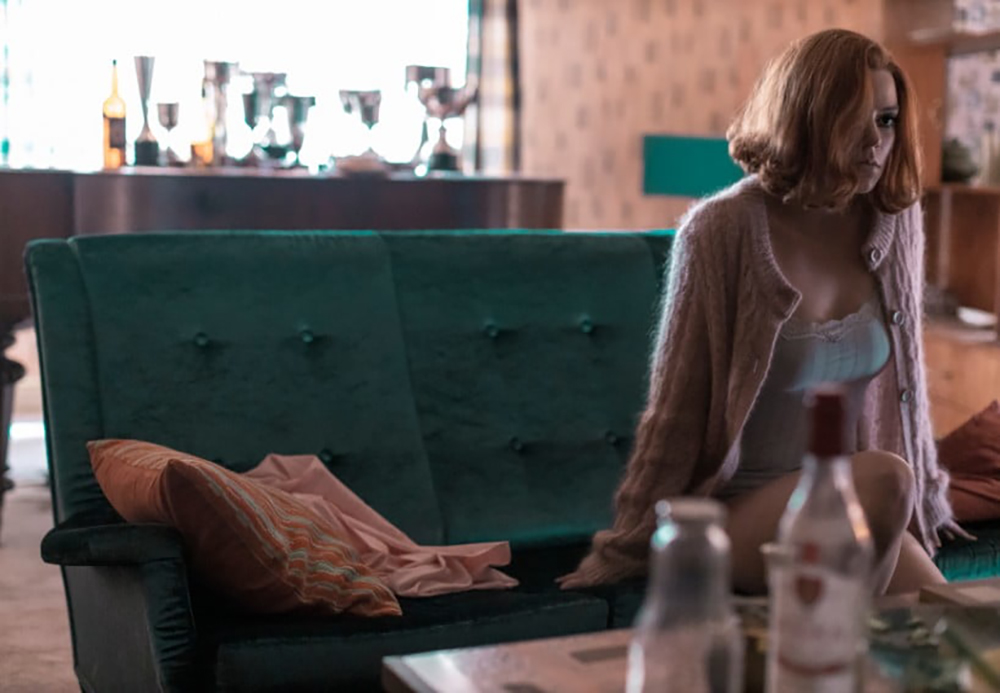
The period of the 1960s that âThe Queen’s Gambitâ inhabits is as exquisitely executed as is its emotion. We see grand streets, department stores when that really meant something, bright greens and blues and store letterings, corner drug stores, and the flashy and splendid dress of not just Bethâs hometown, but Las Vegas, Mexico City, Paris, and, of course, Moscow. Steven Miezler is the seriesâ cinematographer, and his shots remind one of a mixture of David Fincherâs cold highlight of emotions coupled with the bright, lavish, larger-than-life shots found in films like âCasinoâ and âAmerican Hustle.â
But under it all thereâs a personal pallor: cameras brought down low to capture Bethâs emotions behind her eyes, and up-close-and-personal cinematography that makes you feel it. âIt,â in this case, is not a chess board, or the thrill of victory, but Bethâs pain, trepidation, excitement, determination, and drive. Not to mention the seriesâ not-so-subtle admonition of the climate of the times, from American nationalism and female empowerment, to the KGB and fear of Communismâall of which are rebuked by the chess community. These are people who know nothing of country or duty, but only a love of chess and a bond with each other that is all but unbreakable.
But apart from these descriptions, what âThe Queenâs Gambitâ is, most of all, is an enchanted view of the human condition and a need for acceptance. It touches on the important things: belonging, acceptance, loving yourself, and is a coming-of-age piece of thoughtful introspection. Itâs an exploration of growth and loss, and, shockingly, a masterclass on an empathetic depiction of alcoholism and addiction. As Beth tumbles down a slippery slope, we feel for her on a human level, not as an after-school special meant to teach lessons, but on a person one. And we feel for those that love her tooâ¦those that make up her true family, even if she canât see it beyond her own pain.
âThe Queenâs Gambitâ is just a marvel. Sure, itâs not without faults. It packs an awful lot into its limited, 7-episode run, and a second viewing shows how fast-paced some of the proceedings can be. But its triumphs outweigh all that. Itâs a story of simplicity yet depth; of emotion over logic, and of love over adversity. It encourages audiences to question their own drives and desires, and to perhaps fall in love with them all over again. And, somehow, âThe Queen’s Gambitâ makes chess an exciting endeavor. The series ends the only way it can, rewarding viewersâ investment into the series, and closes on one of the most joy-inducing and pensive shots of 2020.The show is a high recommend, and not one likely to disappoint.