






In a time period when less than a year ago 20-year-old Michelle Carter was sentenced to 15 months in prison for a series of encouraging text messages to her boyfriend, Conrad Roy III, that led to his eventual suicide, Director Matt Waltingâs funereal âJust Say Goodbyeâ is not only a call to arms for suicide prevention, but, more importantly, awareness.Â
The movie, filmed on a scant budget of $13K, imbues its message slowly, carefully, and without apology. This is an important film, that works not by its acting, but its tone and lasting effect. Suicide in movies is often preceded by motive – as penance for wrongs perpetrated by the offender, or a way to escape inescapable crimes. But we seldom see a focused and unforgiving picture that paints suicide as the disease it is, a disease that affects not just its victims, but those it leaves in its wake.
âJust Say Goodbyeâ is sold to us not by its intended victim Jesse (a subdued actor named Max MacKenzie), but his best friend, Sarah, played by Katerina Eichenberger with a skill so sharp it defies her slim filmography that includes only this, a TV mini series, and an independent short. She learns early in the film that her best friend Jesse intends to take his own life on his birthday, weeks away, coinciding with a trip she has planned to New York City with her father. She takes the news poorly, spending the rest of the film trying to change his mind with everything she knows – reason, emotional entreaty, pleadingâ¦but he seems set in his course.
The adults in this film are absent – physically, emotionally, or both. Jesseâs father (William Galatis) is an unemployed and verbally abusive drunk whose wife killed herself when Jesse was 6-years-old. He doesnât bring this up in healthy ways unless pressed, remarking at one point he drinks because Jesseâs presence reminds him of his wifeâs passing. Thereâs an additional subplot on this, involving a wealthy neighbor and her son Chase that is a constant bully to Jesse, but itâs rather distracting, and to say more would take away from the film as a whole, so I will not comment on it further.


The acting is hit or miss. Eichenberger steals the show, acting circles around Jesse, his father, the aforementioned Chase (Jesse Walters), and most everyone else in equal measure. Sarah is radiant, gorgeous, inspirational, and caring – representing an existence and beauty Jesse could have if he chooses life. In a perfect piece of filmmaking, this beauty exists not as something as clichéd as romance, but something as sublime as the kind of love and acceptance only true friends can offer.
Eichenberger imbues this with ease – sheâs easily the best actor in any indie Iâve seen in the last year or more. This is no more evident than in the filmâs greatest piece of cinematography, as a terrified Sarah, hanging on to fleeting hope, repairs a calendar she has ripped in half – hanging it between one poster that says, âlife is a beautiful ride,â and another that reads, Â âperseveranceâ – in one of the smartest shots Iâve seen in an indie, ever.
As Jesse, MacKenzieâs acting is sardonic and irreverent for most of the film – until he’s forced to confront his feelings for Sarah and, in equal measure, life without her when she will eventually leave him for college, in a scene that is utterly heartbreaking. Walting and writer Layla OâShea couple this with sympathy for Jesseâs character, which is written as an irrational path of self destruction. Jesse often makes you angry at him, while also causing sorrow for the circumstance heâs found himself in. This is especially true toward the filmâs conclusion as he tries all the wrong things to get better while avoiding the one thing he should truly do.


âJust Say Goodbyeâ smartly makes sober commentary on the mental health system, as we discover, through the reading of a heartbreaking letter left to Jesseâs father by his late wife, that she was not âcrazyâ as his father so often minimizes, but suffering from undiagnosed postpartum depression the filmâs characters were ill-equipped to realize.
âJust Say Goodbyeâ makes you anxious, uneasy, afraid. This is its greatest asset and smartest filmmaking choice. A movie like this, that wishes to impart the feelings it does, would do its audience a disservice by making its viewers feel something as common as sadness. Itâs something much deeper and tragic we’re watching unfold here.
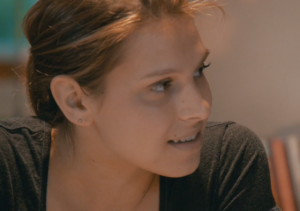

I will not divulge what happens to Jesse. It would be a degradation to this film, which is about the mechanisms and hopelessness of depression – a hopelessness that affects not only its victim, but those closest to him. Weâre meant to feel Jesseâs depression, but, in greater measure, Sarahâs pain and fear. The film accomplishes this remarkably and without error.
At the end of the day this is just a remarkable film. At 1 hour and 46 minutes it never drags. It suffers from some acting missteps and script issues, but its larger impact more than makes up for it. âJust Say Goodbyeâ is still rounding the festival circuit; but if you get the opportunity, do yourself a favor and see this poignant and heartbreaking work.
– by Mark Ziobro


